Stablecoins Are Not Bank Deposits: 7 Checks Before Treating USDC or USDT Like Cash in 2026
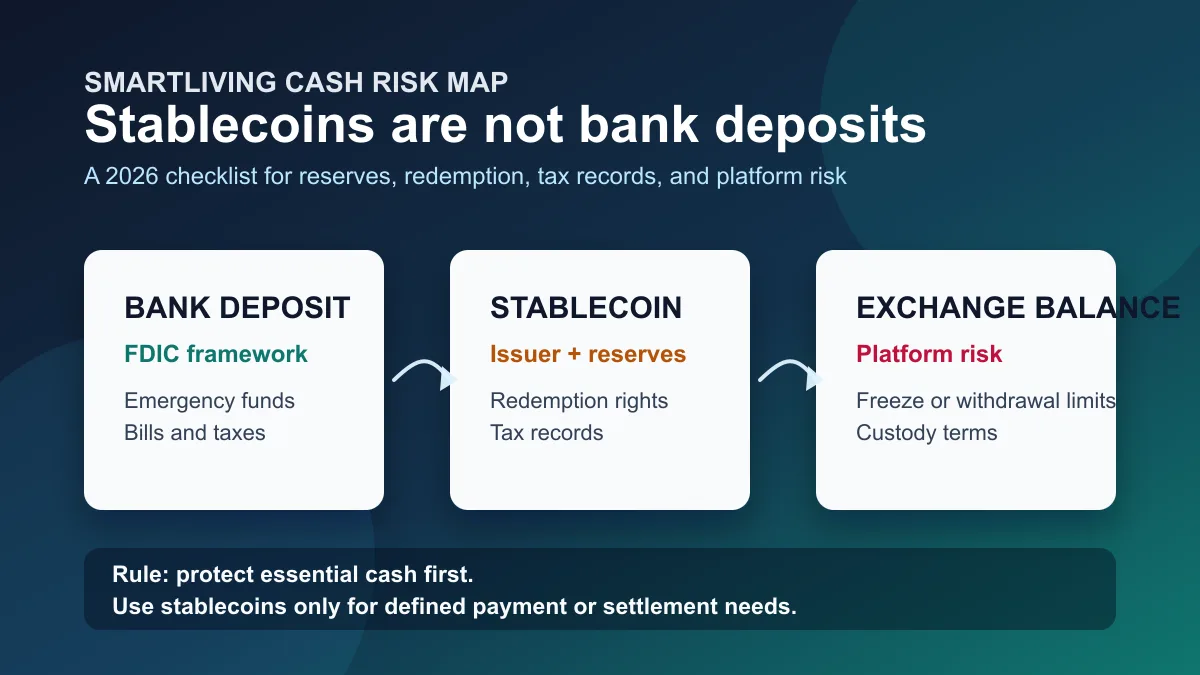
The most dangerous thing about stablecoins is not that they swing wildly every day. It is that they look calm enough to be mistaken for cash.
When a brokerage app, wallet, or crypto exchange shows 10,000 USDC or 10,000 USDT, it is tempting to mentally file it next to a $10,000 bank balance. From a household finance perspective, that is too loose. A stablecoin is not a bank deposit, not an FDIC-insured account, and not automatically the same thing as a Treasury money market fund.
The real question is not whether stablecoins can be useful. The real question is what job you are asking them to do on your balance sheet.
The U.S. regulatory picture changed when the GENIUS Act was signed into law in 2025. The White House said the law subjects stablecoin issuers to Bank Secrecy Act obligations, and Treasury has continued implementation work in 2026, including proposed anti-money-laundering and sanctions-compliance rules. Sources: White House GENIUS Act Fact Sheet and U.S. Treasury GENIUS Act Proposed Rule
That does not mean every wallet balance has magically become a bank account. It means stablecoins are moving into a clearer payment framework, while users still have to understand issuer risk, redemption rights, custody, tax records, fraud risk, and the difference between a token and a deposit.
Bottom Line: A Stablecoin Can Be a Payment Rail, But It Should Not Be Your Core Emergency Fund
Stablecoins can be useful for short-term settlement, crypto trading liquidity, certain cross-border payments, or cases where both parties already understand wallets and off-ramps. They are much weaker as a substitute for rent money, tax money, insurance premiums, tuition, or a six-month emergency fund.
The reason is simple: a bank deposit and a stablecoin balance are different legal and operational relationships. Bank cash sits inside a deposit-insurance and banking-supervision framework. A stablecoin depends on the issuer's reserves, redemption rules, custody structure, network mechanics, platform access, and your ability to keep clean records.
Step 1: Check Whether It Is a Payment Stablecoin or a Yield Wrapper
Start by identifying what you actually hold: a payment stablecoin or a yield product built around a stablecoin. The SEC explains that a stablecoin is designed to maintain stable value relative to a reference asset. A payment stablecoin used for payment or settlement is generally not a security under the GENIUS Act framework, but other stablecoins may be securities depending on their features. Source: SEC Crypto Assets and the Federal Securities Laws
This distinction matters. A plain payment stablecoin already has issuer, custody, and redemption questions. If you add APY, staking, lending, DeFi pools, liquidity rewards, or platform bonuses, you are no longer evaluating only the dollar peg. You are also taking platform, smart-contract, liquidity, counterparty, and regulatory risk.
Step 2: Check Whether You Have Direct Redemption Rights
Next, ask whether you can redeem directly with the issuer at one dollar per token, or whether your only practical exit is selling through an exchange or app. Many retail users never deal directly with the issuer. They hold a platform balance and rely on that platform for withdrawals, trading, account access, and customer support.
FINRA warns that stablecoins still carry crypto-related risks, including cybersecurity, regulatory uncertainty, reserve-asset questions, and the need to understand how collateral is held and verified. Source: FINRA: 3 Things to Know About Stablecoins
Step 3: Do Not Confuse Reserves With FDIC Insurance
This is the line many people blur: reserves are not the same thing as FDIC insurance for token holders. In a 2026 proposed rule related to the GENIUS Act, the FDIC said deposits held as reserves backing a payment stablecoin would not be insured to payment stablecoin holders on a pass-through basis. Source: FDIC GENIUS Act NPR
So even if an issuer keeps part of its reserves at a bank, that is not the same as you having a personal deposit account at an FDIC-insured bank. If your real goal is protected household cash, start with the basics: How FDIC Deposit Insurance Works.
Step 4: Trace the Yield Before You Trust the APY
If a stablecoin product advertises yield, trace where that yield comes from. A 2026 Federal Reserve note says payment stablecoins should be backed by relatively safe assets such as deposits, short-term U.S. Treasuries, or central-bank balances, and notes that the law prohibits a payment stablecoin issuer from directly paying interest, while indirect rewards may still be possible. Source: Federal Reserve: Payment Stablecoins and Cross Border Payments
That means an advertised 5%, 8%, or 12% stablecoin APY is not just a cash-management number. It may come from an exchange incentive, lending activity, market making, a DeFi pool, or another third-party arrangement. The risk is not only whether the token stays near one dollar; it is whether the yield engine survives stress.
Step 5: Count the Four Frictions Before Using Stablecoins for Transfers
Stablecoins can shorten settlement time, especially when wires are slow and the recipient is already comfortable with wallets and exchanges. But fast movement on-chain does not automatically mean the total cost is low.
Before using a stablecoin for a transfer, count four costs: the spread or fee to buy the token, the network fee, the recipient's off-ramp cost, and the time cost if a transfer uses the wrong chain, lands at the wrong address, or gets flagged by a platform. For households and small businesses, the expensive part is often not the fee; it is a payment stuck in the middle with poor documentation.
Step 6: Keep Tax Records Because the IRS Still Treats Stablecoins as Digital Assets
The IRS includes stablecoins in its digital-assets framework. Digital asset transactions may need to be reported, and income from digital assets can be taxable. Sources: IRS Digital Assets and IRS reporting reminder for crypto and digital assets
If a client pays you in stablecoins, the issue is not just whether the token was worth about one dollar. You need the U.S. dollar fair market value when received, the nature of the income, your basis, any fees, and any later exchange or sale. Freelancers, small-business owners, and cross-border sellers should keep records as they go instead of trying to reconstruct a year of CSV exports at tax time.
Step 7: Put Scam Controls Ahead of Convenience
The FTC's crypto-scam guidance is blunt: guaranteed profits, fast-return promises, dating-app investment advice, and requests to send crypto are major red flags. Source: FTC: What To Know About Cryptocurrency and Scams
Stablecoins are especially useful to scammers because they feel dollar-like and move quickly. If someone asks you to convert cash to stablecoins, send funds to a wallet address, unlock an account, earn a rebate, join an arbitrage pool, or follow a romantic or social-media contact into a crypto transfer, stop first. You can also use these SmartLiving guides as a safety layer: AI voice deepfake scam protection and how to avoid online money-transfer scams.
Where Should $10,000 Sit? Four Dollar-Like Balances Are Not the Same
| Where the money sits | Looks like cash? | Main protection | Main risk | Better use case | | --- | --- | --- | --- | --- | | FDIC-insured bank account | Yes | FDIC insurance when eligible | Coverage limits, ownership-category mistakes | Emergency fund, bills, taxes, rent | | Money market fund or short Treasury fund | Mostly | Securities account and fund structure, not FDIC insurance | Rate, liquidity, and fund risks | Cash that is not needed today | | Payment stablecoin | Mostly | Issuer reserves, redemption rules, regulation | Redemption, custody, network, platform, compliance risks | Payment, settlement, short-term crypto liquidity | | Crypto exchange balance | Mostly | Platform terms and custody setup | Withdrawals paused, bankruptcy, account freeze | Short-term trading operations only |
The point is not that one option is always best. The point is that the legal relationship changes even when the screen shows a dollar amount. Rent money, tax money, insurance premiums, and emergency reserves should sit in places that are easy to explain, easy to access, and clearly protected. Stablecoin balances should be limited to amounts you actually need for payment, settlement, or short-term crypto operations.
A SmartLiving Cash-Layer Framework for Stablecoins
- Layer 1: Safety cash. Rent, mortgage payments, insurance, taxes, tuition, and emergency savings belong first in FDIC-insured bank accounts or other clearly understood cash tools.
- Layer 2: Operating liquidity. If you have a real on-chain payment or cross-border settlement need, keep only the short-term working amount in stablecoins.
- Layer 3: Yield or experimentation money. DeFi, platform rewards, lending, and high-APY products should be funded only with money you can afford to risk and track properly.
- Layer 4: Do-not-risk money. Tax reserves, emergency medical cash, down payments, insurance premiums, and essential family cash should not chase a few extra points of APY through platform or smart-contract risk.
Stablecoin Self-Check
- [ ] I know the issuer, not just the exchange or wallet brand.
- [ ] I have reviewed recent reserve information and understand it is not FDIC deposit insurance.
- [ ] I know whether I have direct redemption rights or only a platform exit.
- [ ] I know the difference between exchange custody, wallet custody, and self-custody.
- [ ] I know where any advertised yield actually comes from.
- [ ] I keep transaction records, timestamps, dollar values, and fees.
- [ ] I do not store emergency funds, rent, tax money, or insurance premiums in stablecoins for long periods.
- [ ] If someone asks me to send stablecoins, I verify identity, purpose, and scam risk before moving funds.
Final Takeaway
Stablecoins are not useless, and they are not risk-free dollars. They are best understood as conditional payment and settlement tools, not as the foundation of a household emergency fund.
If you use them, put them into a cash-layer system first. Decide which dollars must be protected, which dollars are only for short-term movement, and which dollars are experimental. Once those lines are clear, a stablecoin balance stops pretending to be the same thing as a bank dollar.
Disclaimer: This article is for general financial education and risk-awareness purposes only. It is not investment, tax, legal, banking, crypto-asset, or personal financial advice. Stablecoin and digital-asset rules continue to evolve. Before making transaction, payment, tax, or cross-border transfer decisions, consult a qualified tax, legal, or financial professional.
Related Financial Decisions
Keep using the same cash-flow lens on related decisions.
Should You Break a CD After a Fed Rate Hike? Calculate the Switching Cost
A higher CD rate may not cover the early withdrawal penalty. Compare a $20,000 example over the same six months, calculate the break-even rate, and avoid APY and brokered-CD mistakes.
finance2026 Trump Account Guide: The $1,000 Child Savings Account vs. a 529 Plan
Trump Accounts are live. This 2026 family finance guide explains who may qualify for the $1,000 federal contribution, whether parents should add more money, and how Trump Accounts compare with 529 plans.
financeWhere to Park Cash in 2026: HYSA, CDs, T-Bills, and Money Market Funds
Cash still earns meaningful yield in 2026, but HYSA, CDs, T-Bills, money market deposit accounts, and money market funds are not interchangeable. This guide builds a practical cash ladder using Fed, TreasuryDirect, FDIC, NCUA, and SEC sources.
SmartLiving Tools
Keep running the numbers with free practical tools.