Where to Park Cash in 2026: HYSA, CDs, T-Bills, and Money Market Funds
If you have cash in 2026, the question is no longer simply "which account pays the highest APY?"
That question is too small. A high-yield savings account, a CD, a Treasury bill, a money market deposit account, and a money market fund may all look like cash tools on a screen. Under the hood, they are different products with different insurance rules, liquidity, tax treatment, and failure points.
That difference matters when you need the money quickly, when rates move, when tax forms arrive, or when you are holding more than the basic insured amount.
The Federal Reserve's July 29, 2026 FOMC statement kept the federal funds rate target range at 3.50% to 3.75%. Federal Reserve H.15 data still showed meaningful short-term Treasury yields around that period: on August 4, 2026, the secondary-market Treasury bill yield was 3.62% for 4 weeks, 3.74% for 3 months, 3.83% for 6 months, and 3.87% for 1 year. Sources: Federal Reserve July 29, 2026 FOMC statement and Federal Reserve H.15 Selected Interest Rates.
So cash still has yield. But yield is only one part of the decision.
The better question is this: which job does each layer of your cash need to do?
Step 1: Divide Cash Into Layers Before Choosing Products
The biggest cash-management mistake is treating every dollar of cash as the same kind of money. Next week's rent money and a home down payment you may use in two years should not be managed the same way.
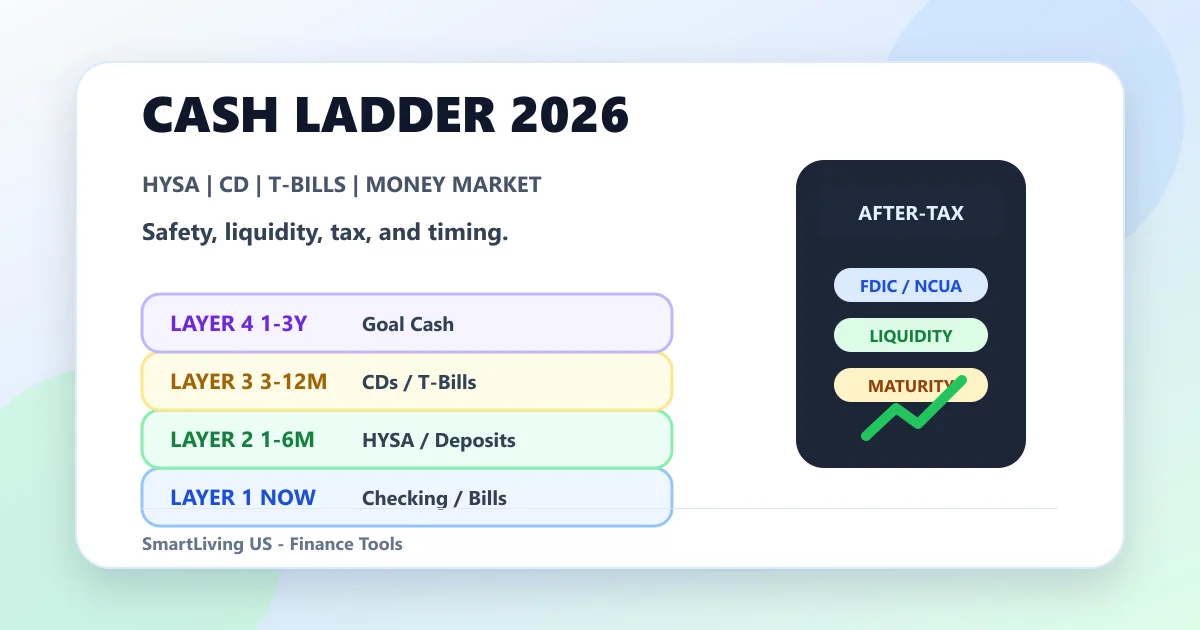
Use a simple four-layer framework:
| Cash layer | Time horizon | Main job | Common tools | | :--- | :--- | :--- | :--- | | Layer 1 | 0-30 days | Immediate bills and transfers | Checking, basic savings | | Layer 2 | 1-6 months | Emergency fund access | HYSA, money market deposit account | | Layer 3 | 3-12 months | Better yield without locking everything | Short CDs, T-Bills, Treasury money market funds | | Layer 4 | 1-3 years | Known future goals with low volatility | T-Bill ladder, CD ladder, short Treasury tools |
The table is not a prescription. It is a discipline. Cash needs a job before it needs a yield.
If your emergency fund is not built yet, start with SmartLiving's guide here: Debt Payoff vs Emergency Fund: Which Comes First?. Cash ladders work best when you know which dollars cannot be locked up.
Step 2: HYSA Belongs in the Emergency Layer, But APY Is Not the Only Test
High-yield savings accounts are useful because they combine yield with relatively simple access. For emergency cash, that is often exactly the point.
But the first test is not APY. The first test is whether the money is actually in an insured deposit product at a bank or federally insured credit union.
FDIC explains that the standard deposit insurance amount is $250,000 per depositor, per insured bank, for each account ownership category. FDIC insurance covers deposit products such as checking accounts, savings accounts, money market deposit accounts, and CDs. It does not cover stocks, bonds, mutual funds, ETFs, crypto assets, or other investment products. Source: FDIC Deposit Insurance at a Glance.
If you hold several accounts or use a platform that deposits cash at partner banks, work through our FDIC coverage examples for single, joint, and platform-held deposits before assuming each account has a separate limit.
For credit unions, NCUA share insurance plays a similar role at federally insured credit unions. NCUA says the Share Insurance Fund is backed by the full faith and credit of the U.S. government, while also noting that stocks, bonds, mutual funds, annuities, digital assets, and similar products are not insured by the Share Insurance Fund. Source: NCUA Share Insurance Coverage.
Before moving emergency cash, ask:
- Is this an FDIC-insured bank or federally insured credit union?
- Is this a deposit product, not an investment product with a bank-like name?
- How fast can you transfer money out?
- Are there ACH limits, withdrawal limits, holds, or account restrictions?
- If balances exceed $250,000, do you understand the ownership category and institution-level coverage?
Chasing an extra 0.15% may feel smart. But if it moves your emergency fund to a platform you do not understand, the tiny yield pickup may not be worth the operational risk.
Step 3: CDs Can Lock Yield, But They Can Also Lock You In
CDs can be useful for cash you truly do not need for a set period. A CD at an FDIC-insured bank is generally a deposit product, and the maturity date is clear.
The problem is that people often confuse "I hope I will not need this money" with "I definitely will not need this money."
Those are different sentences.
If you put $20,000 into a 12-month CD and then need the money in three months, an early withdrawal penalty can erase part of the benefit. The exact penalty depends on the institution and terms. You also need to check whether the CD auto-renews at maturity, how long the grace period is, and whether the CD is callable.
A CD ladder can reduce that all-or-nothing problem. Instead of locking $30,000 for 12 months, you might split it across 3-month, 6-month, 9-month, and 12-month maturities while keeping some cash in savings.
That is less exciting than calling the perfect rate peak. It is also more useful for real households.
Step 4: T-Bills Fit the Middle Layers, Especially in High-Tax States
TreasuryDirect says Treasury Bills are sold with terms ranging from 4 weeks to 52 weeks. Bills are sold at a discount or at par, and when the bill matures, you receive its face value. You can hold a bill until maturity or sell it before maturity. Source: TreasuryDirect Treasury Bills.
For readers in high-tax states, T-Bills deserve a closer look. TreasuryDirect's tax page says earnings from Treasury marketable securities are subject to federal tax but exempt from state and local taxes. For bills, the taxable "interest" is the difference between the price you paid and the face value you receive at maturity. Source: TreasuryDirect Tax Forms and Tax Withholding.
That tax treatment means you should compare after-tax yield, not just headline yield. A HYSA interest payment may face federal, state, and local income tax. T-Bill interest is still federally taxable, but it is generally exempt from state and local taxes.
T-Bills are not perfect cash, though. TreasuryDirect is not a checking account. If you buy through TreasuryDirect, the experience is different from holding cash at a bank or brokerage. If you sell before maturity, market rates may affect the price. If your goal is "I need this money tomorrow morning," a T-Bill is probably not the right layer.
Use T-Bills when the time horizon fits.
Step 5: Money Market Funds Are Not Money Market Deposit Accounts
This is one of the most important distinctions in cash management.
A money market deposit account is a bank deposit product. A money market fund is a mutual fund. The names are similar. The protections are not.
Investor.gov explains that money market funds are mutual funds that invest in liquid, short-term debt securities, cash, and cash equivalents. Many investors use them as cash storage or as an alternative to bank savings vehicles. But the SEC investor bulletin also says money invested in a money market fund is not guaranteed by the FDIC like a bank account, and investors may lose some or all of the money invested. Source: Investor.gov Money Market Funds Investor Bulletin.
That does not make money market funds bad. Government money market funds and Treasury money market funds can be useful tools for brokerage cash. The point is that they are funds, not deposits.
SIPC adds another layer of confusion. Investor.gov's SIPC bulletin explains that SIPC protection helps address the risk of losing securities and related cash if a SIPC-member brokerage firm fails, but it does not protect you against a decline in the value of your securities. It also distinguishes brokerage cash, money market funds, and bank sweep programs. Source: Investor.gov SIPC Protection Basics.
Before using a brokerage cash option, ask:
- Is my cash in a bank sweep or a money market fund?
- If it is a bank sweep, which banks hold the cash and what are the FDIC limits?
- If it is a money market fund, what type of fund is it?
- What are the fund's fees, holdings, liquidity rules, and tax treatment?
That is the real cash-management work. The yield number is only the start.
Step 6: Stablecoins Do Not Belong in the Emergency-Fund Layer
Stablecoins may look like digital cash. For certain use cases, they can be useful. But for household cash management, they do not belong in the same layer as FDIC-insured deposits, T-Bills, or CDs.
Your mortgage, rent, insurance, taxes, car payment, and credit card bill still usually settle through the traditional dollar banking system. Stablecoins bring issuer risk, custody risk, exchange risk, wallet risk, chain risk, fraud risk, and conversion risk. They may move 24/7, but that does not make them emergency cash.
For a deeper breakdown, see SmartLiving's guide: Are Stablecoins a Cash Substitute? 2026 Risk and Tax Guide.
A Practical 2026 Cash Ladder Template
This is not investment advice. It is a planning template you can adjust for your income stability, tax state, debt load, and upcoming goals.
| Goal | Practical approach | Possible tools | Avoid | | :--- | :--- | :--- | :--- | | Current bills | Keep it boring | Checking, basic savings | Chasing yield | | 1-3 months emergency cash | Safety and access first | FDIC/NCUA-covered HYSA | Investment products you do not understand | | 3-12 months reserve | Stagger maturities | T-Bills, short CDs, HYSA | Locking everything at once | | 1-3 year goal | Low volatility and tax awareness | T-Bill ladder, CD ladder, short Treasury tools | Long-duration bond funds for known short-term goals | | High-tax-state cash | Compare after-tax yield | T-Bills, Treasury money market fund, HYSA | Comparing nominal APY only | | Brokerage idle cash | Understand the structure | Bank sweep or government money market fund | Treating SIPC like FDIC |
If rate headlines are making every money decision feel urgent, pair this with SmartLiving's broader rate-cycle guide: Rate Cuts, HYSA, CDs, Bonds, and Mortgage Refinancing.
Final Takeaway
Cash is not lazy. Cash is optionality.
The goal is not to squeeze the highest possible yield out of every dollar. The goal is to make sure each dollar is standing in the right place when you need it.
Use checking for immediate bills. Use insured savings for emergency access. Use CDs and T-Bills when the maturity fits the goal. Use money market funds only when you understand that they are investment products, not bank deposits. Keep stablecoins out of the emergency-fund layer unless you have a very specific reason and understand the risk.
The best cash strategy in 2026 is not the one with the prettiest APY.
It is the one that still works when life interrupts your spreadsheet.
Disclaimer: This article is for general financial education and household cash-management planning only. It is not investment, tax, legal, insurance, or personalized financial advice. Interest rates, APYs, T-Bill yields, fund yields, tax rules, insurance coverage, and product terms change over time. Review official materials from banks, brokers, funds, TreasuryDirect, FDIC, NCUA, SEC, IRS, and qualified professionals before acting.
Related Financial Decisions
Keep using the same cash-flow lens on related decisions.
Should You Break a CD After a Fed Rate Hike? Calculate the Switching Cost
A higher CD rate may not cover the early withdrawal penalty. Compare a $20,000 example over the same six months, calculate the break-even rate, and avoid APY and brokered-CD mistakes.
financeStablecoins Are Not Bank Deposits: 7 Checks Before Treating USDC or USDT Like Cash in 2026
A practical 2026 guide to stablecoins, FDIC insurance, redemption risk, platform balances, taxes, scams, and when a stablecoin should or should not be treated like cash.
financeRate Cuts, HYSA, CDs, Bonds, and Mortgage Refinancing: What Should You Actually Do?
Rate-cut headlines can make every money decision feel urgent. This 2026 guide explains how to think about high-yield savings, CDs, bonds, emergency funds, and mortgage refinance break-even math.
SmartLiving Tools
Keep running the numbers with free practical tools.