2026 Property Tax Appeal Guide: When an Escrow Jump Is Worth Fighting
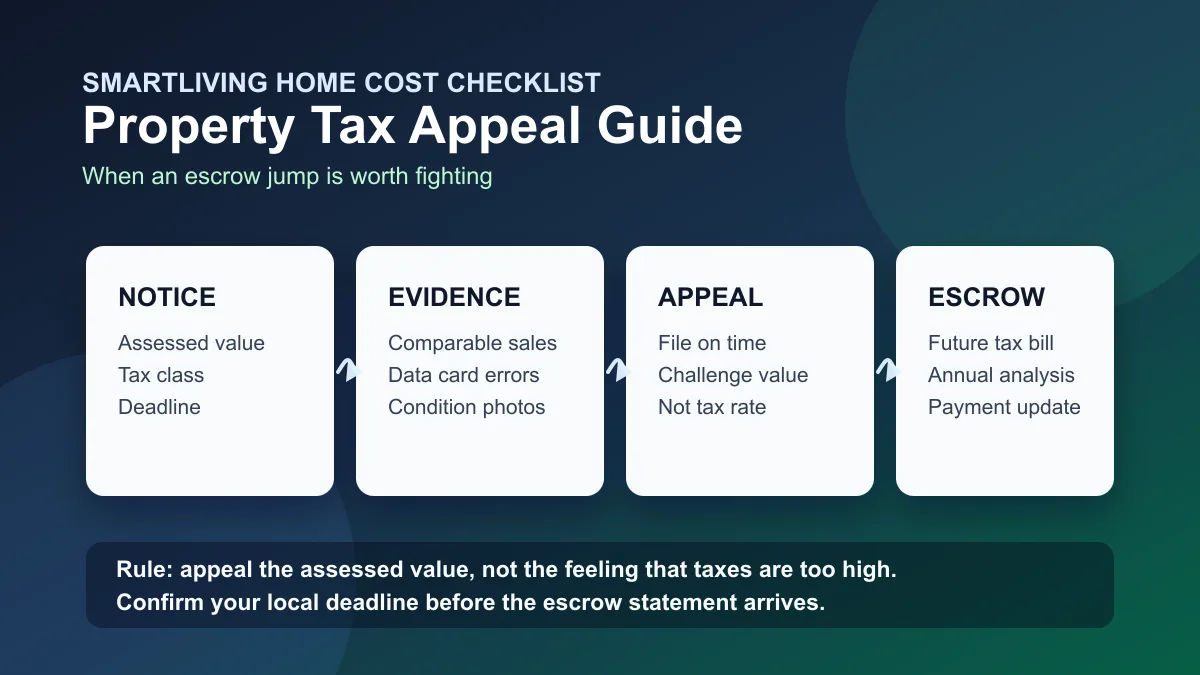
Your escrow went up, and property tax is the reason
You read your annual escrow statement, separated the payment into pieces, and the line that moved was property tax. Principal and interest are fixed. Insurance was roughly flat. The increase is the tax bill.
So now there is a different question.
Not "why did my payment go up." You already answered that.
The new question is: can you challenge the property tax itself, and is it worth the effort?
This guide is about that decision. It does not promise your taxes will fall. Many homeowners never check whether an appeal is available, while some who do appeal are challenging the wrong number. The goal here is to help you tell those two situations apart before you spend a weekend on it.
If you have not yet confirmed that escrow, and specifically property tax, is the part that rose, read the bill-reading guide first: Escrow Shortage Added $275: Why a Fixed-Rate Mortgage Payment Rose in 2026.
A property tax appeal challenges the assessed value, not the bill
This is the single most important idea in the entire guide, and most people get it wrong.
You cannot appeal your property tax because it feels too high. You cannot appeal because your income dropped, because the rate went up, or because you disagree with how the town spends money. Those are real frustrations, but they are not grounds for an appeal.
A property tax bill is built from two numbers the homeowner does not set together:
| Component | Who sets it | Can you appeal it? | | :--- | :--- | :--- | | Assessed value of your property | The local assessor | Yes — this is what an appeal challenges | | Tax rate / mill rate | The local taxing budget | No — that is a budget, not an assessment |
An appeal is a claim that the assessor's value is wrong, not that the tax is unfair. New York State, for example, lets owners contest an assessment mainly on the grounds that it is an excessive assessment — the assessed value exceeds the property's full market value — or an unequal assessment — the property is assessed at a higher percentage of market value than comparable properties on the roll. Source: New York State Department of Taxation and Finance: Contest your assessment.
So before anything else, find the assessed value on your assessment notice and ask one question:
Is the assessor saying my home is worth more than it would actually sell for?
If yes, you may have a case. If no, an appeal will probably fail no matter how high the bill feels.
When an appeal is worth it, and when it is not
An appeal costs time, and sometimes a small filing fee or an appraisal fee. It is worth doing when the value is genuinely wrong, and a waste when it is not.
It is usually worth appealing when:
- The assessed market value is clearly higher than recent sale prices of similar nearby homes.
- The assessor's record has factual errors: wrong square footage, an extra bathroom you do not have, a finished basement that is not finished, wrong lot size.
- Comparable neighbors with similar homes are assessed noticeably lower than you.
- The home has condition problems — structural, water, foundation, a roof at end of life — that a mass assessment did not account for.
- You recently bought the home for less than its assessed value in an arm's-length sale.
It is usually not worth appealing when:
- Your assessed value is at or below what your home would realistically sell for.
- You are comparing your tax to a neighbor with a smaller or different home.
- The only thing that changed is the tax rate, not the value.
- Your potential savings are small and the process in your area is long and formal.
Run a rough number before deciding. If your assessment looks 10% too high and that 10% maps to a few hundred dollars a year, that recurring saving can be worth a few hours. If it maps to $40 a year, your time is worth more than the appeal.
The evidence that actually moves an appeal
An appeal is won with evidence, not with frustration. A board hears the same complaint every spring; what separates a successful grievance is documentation.
Gather these before you file:
- The assessment notice itself. Confirm the assessed value, the assessment date, the deadline, and how your jurisdiction converts assessed value to estimated market value.
- Comparable sales (comps). Three to five recent arm's-length sales of genuinely similar homes nearby — similar size, age, lot, and condition. Recent matters more than close. A foreclosure or a sale between family members is not a clean comp.
- The assessor's own data card for your property. Check every fact: square footage, bedroom and bath count, lot size, year built, finished space. A factual error is the easiest kind of appeal to win because it is not an opinion.
- Photos of condition problems. A failing roof, foundation cracks, water damage, an unfinished area the record calls finished. Date the photos.
- Repair estimates or inspection reports for any major condition issue, if you have them.
- A recent purchase price, if you bought below the assessed value in a normal sale, with the closing statement.
- An independent appraisal, in higher-stakes cases where the potential tax saving justifies the appraisal cost.
You are not trying to argue that taxes are too high. You are trying to show, on paper, that the number the assessor used is not what the home is worth.
Deadlines are short, and missing one usually ends it for the year
This is where most appeals die — not at the hearing, but in the calendar.
Assessment appeal windows are set locally and they can be narrow. In New York State, owners generally file Form RP-524, Complaint on Real Property Assessment, and in most communities the deadline is Grievance Day, the fourth Tuesday in May — though the date varies by locality and you must confirm it with your assessor. Source: New York State Department of Taxation and Finance: Grievance procedures.
New York City is different. NYC property owners generally deal with the NYC Tax Commission rather than the standard town grievance calendar. The Tax Commission listed 2026 assessment-appeal deadlines of March 16 for Class 1 and March 2 for Classes 2, 3, and 4, and says those deadlines cannot be waived or extended. Always check the current year and your tax class on the official NYC page before relying on any general New York State deadline. Source: NYC Tax Commission.
Two things make the deadline dangerous:
First, by the time the higher tax shows up in your escrow statement from the mortgage servicer, the appeal window for that assessment may already be closed. The servicer's bill is downstream of the assessment by months.
Second, the deadline is usually tied to the tentative assessment roll, not to when you receive a bill. You often have to challenge a value before it has even turned into a tax you can see.
So the practical move is: do not wait for the escrow statement to tell you the tax went up. Check your assessment when the tentative roll is published, find your local deadline now, and put it on a calendar. If you miss it, the usual answer is that you wait until next year's roll.
A successful appeal does not lower your escrow overnight
Suppose you win. Your assessed value is reduced. Here is the part that surprises homeowners: your monthly mortgage payment may not drop the next month.
Property tax flows into your payment through escrow, and escrow adjusts on the servicer's schedule, not yours. The Consumer Financial Protection Bureau explains that when your mortgage payment includes escrow, the payment changes when the property tax or insurance amounts the servicer pays change — and the servicer recalculates escrow during its escrow analysis, typically annually. Source: CFPB: Why did my monthly mortgage payment go up or change?.
What that means in practice:
- A lower assessment lowers the future tax bill the servicer pays on your behalf.
- Your monthly escrow portion usually adjusts at the next escrow analysis, not instantly.
- If your account built up a surplus because the tax came in lower than projected, the servicer's escrow analysis governs how that surplus is handled. The servicer's annual analysis is the moment the new, lower number actually shows up. Source: CFPB Mortgage Servicing FAQs.
So the right expectation is: an appeal fixes the bill at the source, and the payment catches up on the servicer's cycle. If you win an appeal, tell your servicer and watch the next escrow analysis rather than expecting an immediate change.
A quick note on the tax deduction, because the rule changed
Many homeowners ask whether a higher property tax at least helps at tax time. The deduction rules shifted recently, so the old assumption is out of date.
State and local real property taxes are generally deductible if you itemize. For 2025 returns, the IRS says the overall deduction limit for state and local taxes — income or sales, plus property — rose to $40,000 ($20,000 if married filing separately), with the cap reduced for higher incomes (modified adjusted gross income above $500,000, or $250,000 if married filing separately) but not below $10,000. Source: IRS Publication 530, Tax Information for Homeowners; IRS Topic No. 503, Deductible taxes.
Two cautions:
- Charges that are really for local benefits or specific services — building streets, sidewalks, or water and sewer systems that increase your property's value — are generally not deductible as real estate tax, even when they appear on the same bill. Source: IRS Publication 530.
- A deduction reduces taxable income; it does not refund the tax dollar for dollar. Reducing a wrong assessment is still the larger lever for most homeowners than the deduction on the higher bill.
Confirm your own situation with a CPA or tax professional; the cap, the phase-out, the filing year, and itemizing-versus-standard all depend on your full return.
Screenshot-friendly property tax appeal checklist
Work through these in order before deciding to appeal:
- [ ] Confirm property tax — not insurance or a shortage — is the line that rose.
- [ ] Find the assessed value and the estimated market value on your assessment notice.
- [ ] Ask whether the assessor's market value is higher than your home would sell for.
- [ ] Pull 3–5 recent sales of genuinely comparable nearby homes.
- [ ] Check the assessor's data card for factual errors in size, rooms, and lot.
- [ ] Photograph any condition problems and date the photos.
- [ ] Find your local appeal deadline now (do not wait for the escrow statement).
- [ ] Estimate the annual saving and compare it to the effort required.
- [ ] File the correct local form before the deadline.
- [ ] If you win, notify your servicer and watch the next escrow analysis.
- [ ] Recalculate your real total housing payment with the Mortgage Calculator.
If you do only one thing, do the first one and the seventh one: confirm the cause, then find the deadline. Everything else can be built once you know you are challenging the right number, in time.
Where this fits in the bigger housing-cost picture
A property tax appeal is one tool in a larger 2026 problem: the cost of owning a home keeps moving even when the loan does not.
If your payment rose, separate the causes and address each at its source rather than reaching for a refinance:
- If the assessment is wrong, appeal it — this guide.
- If homeowners insurance drove the increase, compare coverage rather than just price: Homeowners Insurance Premium Audit Guide 2026.
- If you are still paying PMI, check whether you can cancel it: Private Mortgage Insurance (PMI) Cancellation Guide 2026.
- If the whole escrow statement confused you, start with the bill-reading guide: Escrow Shortage Added $275.
A fixed-rate mortgage stabilizes the loan. It does not stabilize the assessor's opinion of what your home is worth. That opinion is the one number on your tax bill you are actually allowed to argue with — so when it is wrong, it is worth knowing how.
Disclaimer: This article is for educational and general informational purposes only. It is not tax, legal, mortgage, or personalized financial advice. Property assessment and appeal rules vary by state, county, city, and assessing jurisdiction, and deadlines and forms differ by locality. Confirm your assessment notice, local appeal deadline, and required forms with your local assessor or tax authority, and confirm any tax-deduction question with a CPA or qualified tax professional before acting.
Related Financial Decisions
Keep using the same cash-flow lens on related decisions.
HELOC vs Cash-Out Refinance in 2026: Should You Tap Home Equity?
Home values are up, but home equity is not free cash. A 2026 guide to comparing HELOCs, home equity loans, and cash-out refinancing through payment shock, tax rules, and household cash flow.
finance2026 PMI Cancellation Guide: When Can You Stop Paying Private Mortgage Insurance?
Private mortgage insurance is not always permanent. Use CFPB, Fannie Mae, Freddie Mac, and HUD rules to check 80% requests, 78% automatic termination, FHA MIP differences, and cash-flow math.
financeHomeowners Insurance Jumped in 2026? Audit Coverage Before Chasing the Cheapest Premium
A practical 2026 homeowners insurance audit for mortgage borrowers: escrow impact, deductibles, replacement cost vs. actual cash value, flood gaps, force-placed insurance, and cash-flow risk.
SmartLiving Tools
Keep running the numbers with free practical tools.