2026 PMI Cancellation Guide: When Can You Stop Paying Private Mortgage Insurance?
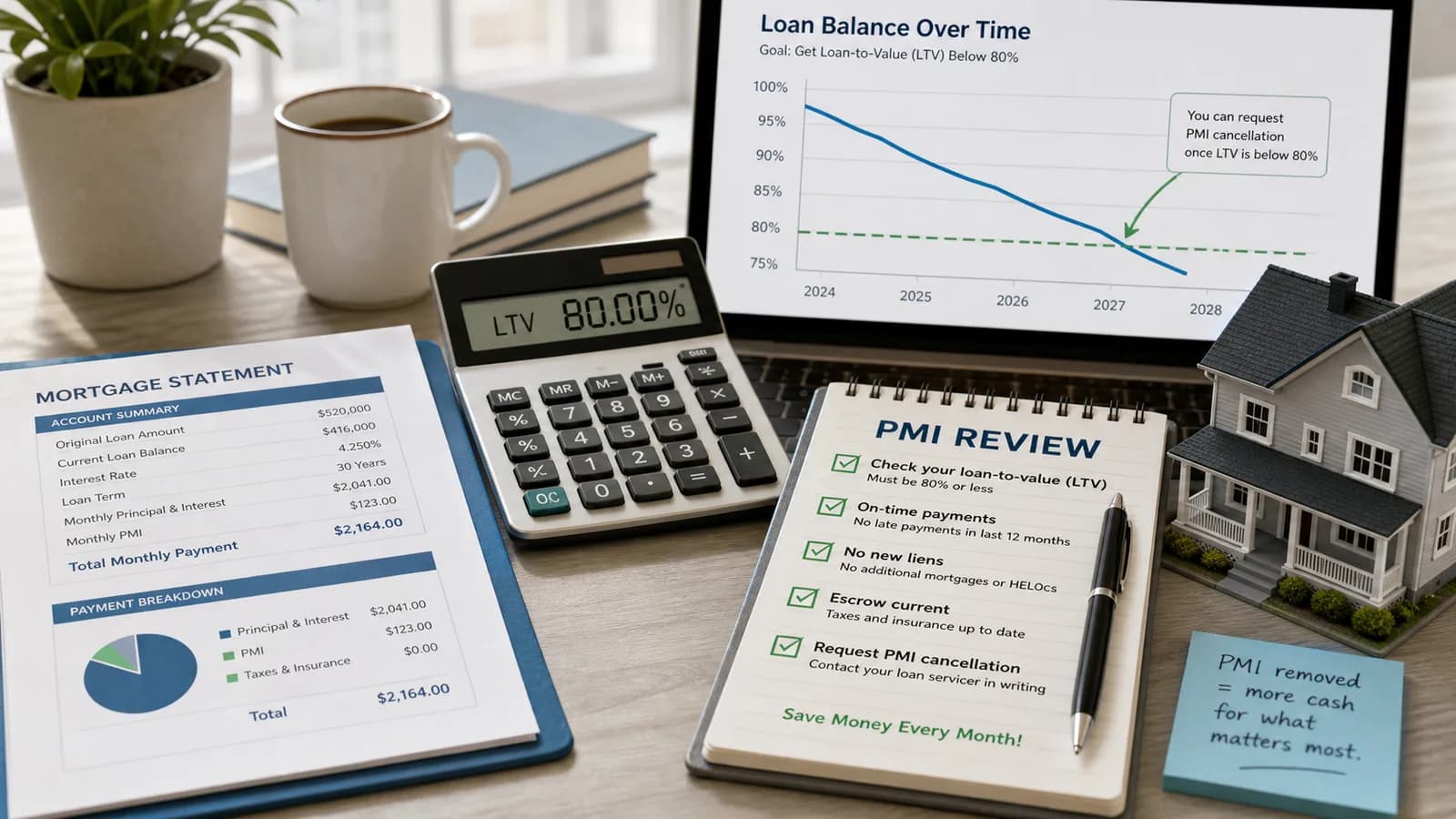
Am I still supposed to be paying PMI?
Many homeowners read the mortgage statement from the top down. Principal and interest get the attention. The smaller line items often become background noise.
PMI is one of those line items.
It may be $80, $150, or $250 per month. After a while, it feels like part of the mortgage itself. But for many conventional borrowers, private mortgage insurance is not supposed to be permanent.
The Consumer Financial Protection Bureau defines private mortgage insurance as a type of mortgage insurance that may be required on a conventional loan when the down payment is less than 20 percent. It protects the lender, not the borrower, if the borrower stops making payments. Source: CFPB: What is private mortgage insurance?
This guide is not about predicting home prices or refinancing. It is about checking whether the PMI line on your mortgage statement has reached the point where you can ask to remove it.
The Short Answer
If you have borrower-paid PMI on a conventional loan, remember three thresholds.
| Threshold | What it may allow | Key condition | | :--- | :--- | :--- | | 80% LTV | You may request PMI cancellation | Written request, good payment history, current payments, no junior liens, possible valuation evidence | | 78% LTV | PMI is generally automatically terminated | Usually based on the original amortization schedule and current payment status | | Midpoint of loan term | PMI may have to end | For a 30-year loan, this is usually after 15 years, assuming the loan is current |
The CFPB explains that borrowers have the right to ask the servicer to cancel PMI when the principal balance is scheduled to fall to 80% of the home's original value. Borrowers may also request cancellation earlier if extra payments bring the principal balance down to 80% of the original value. The CFPB also explains that PMI generally must automatically terminate when the scheduled principal balance reaches 78% of the original value, as long as the borrower is current. Source: CFPB: When can I remove PMI from my loan?
That is the key distinction. PMI cancellation is not based on a feeling that the home has gone up. It depends on loan type, original value, balance, payment history, and servicer procedure.
Step 1: Confirm Whether This Is PMI or FHA MIP
Do not start with the 80% math.
Start by confirming what you are paying.
For many conventional loans, the monthly line item is PMI or MI. For FHA loans, the charge is usually mortgage insurance premium, or MIP. The names sound similar, but the cancellation rules are not the same.
The CFPB notes that FHA loans and other loan programs can be more or less expensive than a conventional loan with PMI depending on several factors. Source: CFPB: What is private mortgage insurance?
HUD's FHA guidance is especially important for more recent FHA loans. For FHA case numbers assigned on or after June 3, 2013, annual MIP may be collected for 11 years or for the full loan term, depending on the original loan term and loan-to-value ratio. HUD also states that borrowers may not request early cancellation of annual MIP based on prepayment of principal. Source: HUD: How long is MIP collected for case numbers assigned on or after June 3, 2013?
So before writing a PMI cancellation request, check your Closing Disclosure, monthly statement, or servicer portal. Make sure the line item is actually PMI or conventional MI, not FHA MIP.
Step 2: Calculate LTV Using Original Value
The most misunderstood phrase in PMI cancellation is original value.
For this purpose, the CFPB says original value generally means the lower of the contract sales price or the appraised value at the time the home was purchased. If the loan was refinanced, original value generally means the appraised value at the time of refinance.
The basic formula is simple:
LTV = Current principal balance / Original value
Suppose you bought a home for $520,000, the appraised value was also $520,000, and you made a 10% down payment. The original loan amount was $468,000.
| Item | Amount | | :--- | ---: | | Original value | $520,000 | | 80% threshold | $416,000 | | 78% threshold | $405,600 | | Current loan balance | $417,500 |
In this example, the 80% threshold is $416,000. If the current principal balance is $417,500, the borrower is still $1,500 above that level.
That does not mean you should guess. It means you should ask the servicer a very specific question: if I make a principal curtailment that brings the balance below $416,000, can I submit a PMI cancellation request, and what documentation or valuation do you require?
You can use the SmartLiving Mortgage Calculator to estimate the amortization path and see when the loan may approach 80% or 78%. The calculator does not replace your servicer's official records, but it helps you know whether the request is worth preparing.
Step 3: 80% Is a Request Point, Not an Automatic Stop
Many borrowers think PMI disappears automatically at 80% LTV.
That is not the cleanest way to think about it.
At 80%, you may be able to request cancellation. CFPB lists several conditions: a written request, a good payment history, current payments, a certification that there are no junior liens such as a second mortgage, and evidence that the property value has not declined below the original value if the servicer requires it.
Prepare the request like a file, not like a complaint.
Use this sequence:
- Find the PMI disclosure or ask the servicer for the scheduled 80% date.
- Check the current unpaid principal balance.
- Review payment history for the last 12 and 24 months.
- Confirm whether there is a HELOC, second mortgage, or other junior lien.
- Ask whether the servicer requires an appraisal, broker price opinion, AVM, or other valuation.
- Submit the cancellation request in writing and save a copy.
Fannie Mae's consumer guidance also tells borrowers to contact the loan servicer when the balance reaches 80% of original value to determine whether PMI termination is available. For requests based on the home's current value, Fannie Mae says to contact the servicer to discuss options. Source: Fannie Mae: What to Know About Private Mortgage Insurance
The point is not whether you feel eligible. The point is whether the servicer's required file is complete.
Step 4: 78% Is Automatic, But It Still Has Conditions
The 78% rule sounds easier because it is generally automatic.
But it is not usually based on today's estimated market value. It is usually based on the original value and the loan's scheduled amortization.
The CFPB explains that, in general, the servicer must automatically terminate PMI on the date the principal balance is scheduled to reach 78% of the home's original value. The borrower must be current on payments. If the borrower is not current, PMI is generally not terminated until after the loan is brought current.
That is why home appreciation alone is not the same thing as automatic PMI termination under the basic HPA path.
If you think the servicer failed to terminate PMI when it should have, save the statements, amortization schedule, PMI disclosure, and servicer correspondence. CFPB examination materials have repeatedly treated PMI cancellation and termination as a servicing compliance issue. Source: CFPB HPA examination procedures PDF
Step 5: Can Home Appreciation Help You Cancel PMI Earlier?
Maybe.
But do not treat appreciation-based PMI cancellation as a guaranteed shortcut.
This type of request is usually not just the basic 80% original-value path. It can depend on the investor, servicer, mortgage insurer, current property value, seasoning, property type, and required valuation process.
Fannie Mae's servicing guide separates MI termination based on original value from termination based on current value. Freddie Mac's guide also lists borrower-requested cancellation based on current value with seasoning and LTV conditions. Sources: Fannie Mae Servicing Guide: Termination of Conventional Mortgage Insurance, Freddie Mac Guide Section 8203.2
Plain English version: do not order an appraisal first.
Ask the servicer:
- Who is the loan investor?
- Can I request PMI termination based on current value?
- What LTV do you require?
- What seasoning period applies?
- Who must order the valuation?
- If the value comes in too low, do I still pay the valuation fee?
The break-even math matters. If the PMI is $90 per month and the valuation costs $600, a successful cancellation takes about seven months to recover the valuation cost. If the PMI is $230 per month, the math changes quickly.
| Monthly PMI | Valuation cost | Break-even if cancellation succeeds | | :--- | ---: | ---: | | $75 | $600 | 8 months | | $150 | $600 | 4 months | | $250 | $600 | About 2.4 months |
This table is not a promise that the request will be approved. It is a way to avoid spending money on a process before you know the rules.
Step 6: Why Your Payment May Not Drop as Much as You Expect
If PMI is removed, your mortgage payment may lose one line item.
That is useful.
But the total payment may still feel heavy because property tax, homeowners insurance, escrow shortages, HOA dues, and other housing costs remain.
These two related guides help complete the picture:
- Escrow Shortage Added $275: Why a Fixed-Rate Mortgage Payment Rose in 2026
- Homeowners Insurance Jumped in 2026? Audit Coverage Before Chasing the Cheapest Premium
If PMI is $150 per month but taxes and insurance increased the escrow portion by $190, canceling PMI may offset part of the increase rather than make the entire payment feel lighter.
That is still worth doing.
It just means PMI cancellation is one cash-flow lever, not the whole affordability answer.
A Screenshot-Friendly PMI Cancellation Checklist
Before taking action, check the items in this order:
- [ ] Confirm whether the loan is conventional or FHA.
- [ ] Confirm whether the charge is PMI/MI or FHA MIP.
- [ ] Find the original value.
- [ ] Check the current unpaid principal balance.
- [ ] Calculate current balance / original value.
- [ ] Find the 80% and 78% dates on the PMI disclosure or from the servicer.
- [ ] Review the last 12 and 24 months of payment history.
- [ ] Confirm whether there is a HELOC, second mortgage, or other junior lien.
- [ ] Ask the servicer for the written request address and required documents.
- [ ] Ask whether an appraisal or other valuation is required.
- [ ] Compare valuation cost with monthly PMI savings.
- [ ] If the loan has FHA MIP, check HUD/FHA rules before applying conventional PMI logic.
PMI is easiest to handle with a simple file: date, balance, LTV, request, proof, and servicer response.
Once it is written down, it stops being a vague monthly charge.
It becomes a trackable project.
When You Should Act Now
Act now if your conventional loan is close to 80% of original value or if extra principal payments have already pushed the balance near that level. The gap between 80% request eligibility and 78% automatic termination can still be months or longer, and each PMI payment is real cash.
If you believe home appreciation has created enough equity, ask about the current-value route before paying for an appraisal. Rules can vary by investor, servicer, loan age, and property type.
If the loan is FHA, especially with a case number assigned after June 3, 2013, slow down. The issue may not be PMI cancellation at all. It may be FHA MIP duration. Refinancing into a conventional loan can sometimes remove MIP, but that decision also depends on the new interest rate, closing costs, credit score, DTI, and break-even period.
PMI is not the largest line item in most mortgages.
But it is one of the few line items with a defined exit path.
In a housing market where taxes, insurance, escrow, and repairs are all pressing on household cash flow, any fixed monthly cost with a legitimate off-ramp deserves a careful review.
Disclaimer: This article is for educational and informational purposes only. It is not legal, tax, insurance, lending, or personal financial advice. PMI, MI, FHA MIP, valuation, servicer, and investor rules vary by loan type, location, contract, and institution. Before making extra principal payments, refinancing, canceling mortgage insurance, or changing a loan structure, consult your mortgage servicer, a licensed mortgage professional, or a qualified advisor.
Related Financial Decisions
Keep using the same cash-flow lens on related decisions.
Homeowners Insurance Jumped in 2026? Audit Coverage Before Chasing the Cheapest Premium
A practical 2026 homeowners insurance audit for mortgage borrowers: escrow impact, deductibles, replacement cost vs. actual cash value, flood gaps, force-placed insurance, and cash-flow risk.
financeEscrow Shortage Added $275: Why a Fixed-Rate Mortgage Payment Rose in 2026
Why can a fixed-rate mortgage payment still rise? A practical 2026 CFPB-backed guide to escrow shortages, property tax, homeowners insurance, and a $600k payment example.
financeHELOC vs Cash-Out Refinance in 2026: Should You Tap Home Equity?
Home values are up, but home equity is not free cash. A 2026 guide to comparing HELOCs, home equity loans, and cash-out refinancing through payment shock, tax rules, and household cash flow.
SmartLiving Tools
Keep running the numbers with free practical tools.