HELOC vs Cash-Out Refinance in 2026: Should You Tap Home Equity?
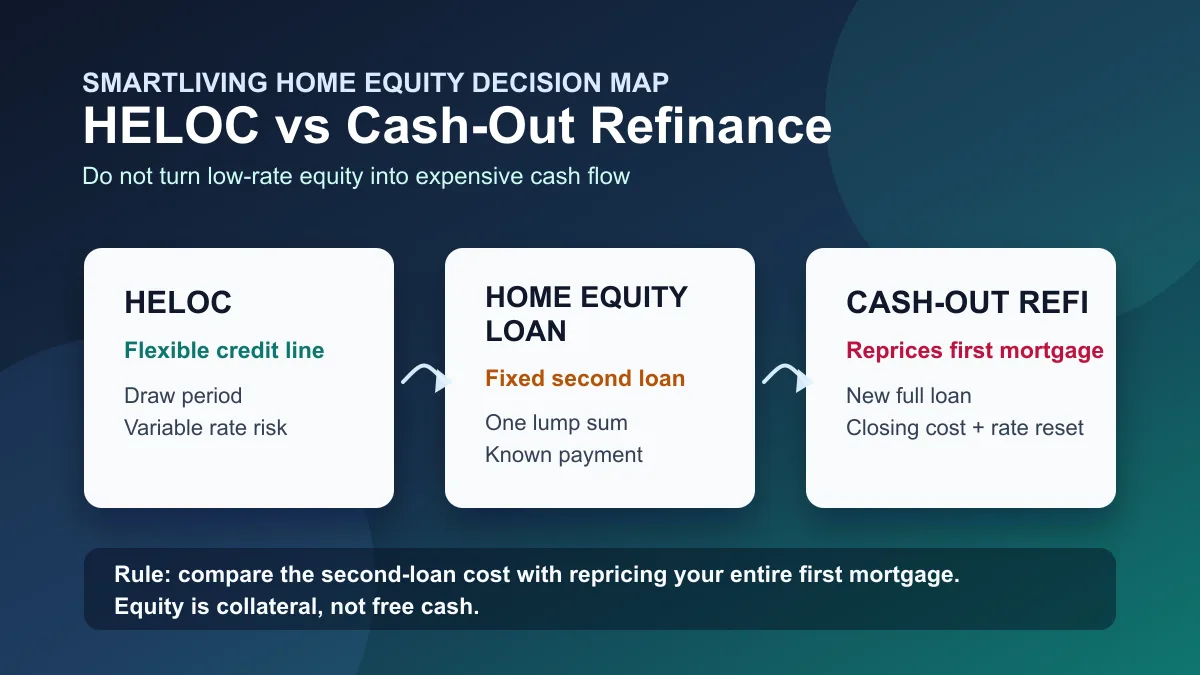
When home values rise, homeowners often feel richer before they actually have more cash.
The money is not sitting in a checking account. It is equity: the difference between what the home may be worth and what you still owe. Lenders, renovation companies, and debt-consolidation ads all know this, so they start using the same language: tap your equity, unlock cash, put your home to work.
That wording makes home equity sound too easy. Equity is not free cash. It is collateral you can borrow against.
This matters in 2026 because mortgage rates are still high enough to make the wrong structure expensive. Freddie Mac's Primary Mortgage Market Survey showed the 30-year fixed-rate mortgage averaging 6.49% as of June 25, 2026. Source: Freddie Mac Mortgage Rates. If your current mortgage is a 3% loan from 2020 or 2021, a cash-out refinance can reprice your entire old mortgage at today's rate just to access a smaller amount of cash.
This guide is not about whether rising home values are good. It is about which home-equity tool, if any, is least likely to damage your household cash flow: a HELOC, a home equity loan, or a cash-out refinance.
First, Separate the Three Tools
The CFPB describes a home equity line of credit, or HELOC, as a loan that lets you borrow, spend, and repay as you go, using your home as collateral. Source: CFPB HELOC booklet. The key difference among HELOCs, home equity loans, and cash-out refinancing is not the marketing name. It is whether you are adding a second loan or replacing the first mortgage.
| Tool | How you get cash | Does it replace the first mortgage? | Rate pattern | Better fit | | --- | --- | --- | --- | --- | | HELOC | Credit line you draw from as needed | Usually no | Often variable | Staged renovations, flexible liquidity, short-term access | | Home equity loan | One lump sum | Usually no | Often fixed | Known project cost and known payoff schedule | | Cash-out refinance | New larger mortgage replaces the old one | Yes | New first-mortgage rate | Only worth serious comparison when the new rate is close to or below your old rate |
That last column is the heart of the decision. A HELOC or home equity loan usually sits on top of the existing mortgage. A cash-out refinance replaces the existing mortgage. For a homeowner with a very low old rate, the expensive part may not be the $50,000 or $80,000 in cash. It may be repricing the entire first mortgage.
Step 1: Ask Whether the Money Improves the House or Fills a Cash-Flow Hole
Start with the use of funds, not the advertised rate.
If the money is for a roof, HVAC system, foundation repair, necessary plumbing, a real addition, or a renovation that substantially improves the home, the borrowing has a cleaner relationship to the collateral. You are borrowing against the house to improve the house.
If the money is for credit cards, a car, investing, business cash flow, living expenses, or taxes, be more careful. That does not automatically make the loan wrong, but it changes the risk. You may be turning unsecured or short-term pressure into debt secured by your home.
The tax rules also draw a line. The IRS says interest on a home equity loan or HELOC is deductible only if the borrowed funds are used to buy, build, or substantially improve the home that secures the loan, and other requirements are met. Sources: IRS Publication 936 and IRS real estate FAQ.
So the common shortcut, "I'll use a HELOC to pay off credit cards and deduct the interest," is usually a misunderstanding. Paying off consumer debt is not the same thing as substantially improving the home that secures the loan.
Step 2: If Your Old Mortgage Rate Is Low, Protect It First
If your first mortgage has a low fixed rate, a cash-out refinance deserves extra skepticism.
Suppose you still owe $500,000 on a 30-year mortgage at 3.25%, and you want to pull out $80,000. If you refinance into a new $580,000 mortgage at a 6.49% 30-year fixed rate, the payment shock is not subtle.
| Scenario | Loan balance | Assumed rate | Estimated 30-year principal and interest payment | | --- | --- | --- | --- | | Keep old mortgage | $500,000 | 3.25% | About $2,176 | | Cash-out refinance | $580,000 | 6.49% | About $3,662 | | Difference | | | About +$1,486/month |
This is not a quote. It is a cash-flow stress test. It shows why a cash-out refinance can be much more than "borrowing $80,000." In this example, you are repricing the full $580,000 mortgage.
A HELOC or home equity loan may carry a higher rate than a first mortgage, but it may avoid disturbing the old loan. The comparison is not simply "which advertised rate is lower?" The better question is: what is cheaper, a second loan on the cash you need, or a new rate on the whole mortgage?
Before making that decision, run both cases in the mortgage calculator: old balance and old rate, then new balance and new rate.
Step 3: With a HELOC, the Problem Often Arrives After the Draw Period
A HELOC can feel harmless at the beginning because it is flexible. You may borrow only what you need, repay, and draw again during the draw period. After that, the loan enters the repayment period, when you generally stop drawing and begin repaying according to the loan terms.
The CFPB booklet warns borrowers to understand draw periods, repayment periods, variable rates, and how payments may change. Source: CFPB HELOC booklet.
That is the trap. Many borrowers focus on the early payment, especially if the draw period allows interest-only or low minimum payments. The real pressure may arrive later, when rates have changed, the balance is larger, and principal repayment begins. At that point, the HELOC stops feeling like flexible cash and starts acting like a large variable-rate bill attached to the home.
Ask the lender these questions before opening one:
- How long is the draw period?
- How long is the repayment period?
- How often can the rate adjust, and is there a lifetime cap?
- If I draw the full line, what could the repayment-period payment look like?
The last question is the real one. Do not only ask what the minimum payment is today. Ask what the payment could become later.
Step 4: A Home Equity Loan Is More Like a Fixed Second Mortgage
A home equity loan trades flexibility for clarity. You usually receive a lump sum, often with a fixed rate, fixed term, and fixed payment.
That can be useful when the cost is known. If the roof is $28,000, HVAC is $14,000, or a necessary structural repair is $35,000, a fixed home equity loan is easier to budget than an open line. The downside is that you borrow the whole amount upfront. Even if the project pays contractors over several months, interest may start on the full principal immediately.
This tool is better for a defined amount, a defined project, and a defined repayment plan. It is weaker for vague "maybe I will need cash later" situations.
Step 5: Debt Consolidation Can Lower the Payment and Raise the Stakes
Many homeowners look at home equity because of credit card debt. If you owe $40,000 on cards at 22%, a lower-rate HELOC or home equity loan can look like an obvious fix.
It may reduce the monthly payment, but it also changes the risk. Credit cards are unsecured. Home-equity debt is secured by the home. If the spending problem continues, the household can end up with both a new home-secured loan and fresh credit card balances.
If you are using home equity for debt consolidation, do at least three things first:
- Stop or freeze the card behavior that created the balance.
- Calculate how many years the new loan will actually take to pay off, not just the lower monthly payment.
- Keep an emergency fund instead of sending every spare dollar into the new loan.
For a broader cash-flow view, pair this with the debt-and-mortgage framework here: Student Loans and Mortgage DTI in 2026.
Step 6: Use This Table to Eliminate the Wrong Option First
| Your situation | Consider first | Be cautious with | | --- | --- | --- | | Low-rate old mortgage, need short-term or staged funds | HELOC or home equity loan | Cash-out refinance | | Known project amount and want fixed payment | Home equity loan | HELOC | | Uncertain or phased borrowing need | HELOC | One-time home equity loan | | Current mortgage rate is close to market and you want one loan | Cash-out refinance can enter the comparison | Looking only at HELOC teaser rates | | Borrowing for consumption or cash-flow gaps | Budget and debt plan first | Turning unsecured debt into home-secured debt | | Borrowing to substantially improve the home | All three can be compared | Ignoring tax-use records |
This table does not decide for you. It helps remove tools that should not be in the final comparison. Many homeowners lose money not because they failed to find the lowest rate, but because they compared the wrong products from the start.
Home Equity Checklist Before You Borrow
- [ ] I know the specific use of funds; I am not borrowing "just in case."
- [ ] I know whether the money will buy, build, or substantially improve the home securing the loan.
- [ ] I compared keeping the old mortgage plus a second loan against repricing the entire first mortgage.
- [ ] I ran old and new payments in the mortgage calculator.
- [ ] If it is a HELOC, I understand the draw period, repayment period, variable rate, and possible future payment.
- [ ] If it is a home equity loan, I understand the fixed payment, term, and total interest.
- [ ] If it is debt consolidation, I have addressed the spending behavior that created the debt.
- [ ] I understand the loan is secured by my home, not just by my credit score.
- [ ] I kept an emergency fund instead of putting every dollar into the new payment.
- [ ] I will keep records showing how the proceeds were used, especially for tax questions.
Final Takeaway
Home equity is real value on your household balance sheet, but it is not automatically free cash. The moment you borrow against it, you are trading future housing security for today's liquidity.
If your old mortgage rate is low, a cash-out refinance should face a high bar. If you need phased borrowing, a HELOC may be flexible, but you must understand the repayment period. If the amount is known, a home equity loan may be clearer, but the interest clock usually starts right away. The smart question is not "which rate is lowest?" It is "which structure does the least damage to my next three to five years of cash flow?"
If your payment problem is really escrow, property tax, or insurance, solve that first before tapping home equity: escrow payment increases, property tax appeals, and homeowners insurance premium audits.
Disclaimer: This article is for general financial education and risk-awareness purposes only. It is not loan, tax, legal, investment, or personalized financial advice. HELOCs, home equity loans, and cash-out refinances vary by lender, state law, credit profile, home value, fees, and tax situation. Before acting, confirm the terms with your lender and consult a CPA, attorney, or qualified financial professional when appropriate.
Related Financial Decisions
Keep using the same cash-flow lens on related decisions.
2026 Property Tax Appeal Guide: When an Escrow Jump Is Worth Fighting
Your escrow rose because property tax went up. A 2026 guide to deciding whether a property tax appeal is worth it, what evidence you need, deadlines, and when escrow actually drops.
finance2026 PMI Cancellation Guide: When Can You Stop Paying Private Mortgage Insurance?
Private mortgage insurance is not always permanent. Use CFPB, Fannie Mae, Freddie Mac, and HUD rules to check 80% requests, 78% automatic termination, FHA MIP differences, and cash-flow math.
financeHomeowners Insurance Jumped in 2026? Audit Coverage Before Chasing the Cheapest Premium
A practical 2026 homeowners insurance audit for mortgage borrowers: escrow impact, deductibles, replacement cost vs. actual cash value, flood gaps, force-placed insurance, and cash-flow risk.
SmartLiving Tools
Keep running the numbers with free practical tools.