Student Loans and Mortgage DTI in 2026: What NYC Buyers Should Check Before Applying
A lot of buyers ask the wrong student loan question.
They ask, do student loans affect buying a home?
The better question is sharper:
How much monthly student loan payment will the lender count in my DTI?
Those are not the same question.
One borrower may have $120,000 in federal student loans and a documented income-driven repayment payment of $280.
Another borrower may have $60,000 in loans, but the credit report shows a $0 payment and the mortgage program requires a percentage of the balance to be counted.
In underwriting, the second borrower may not be easier.
Mortgage underwriting is built around monthly cash flow.
Not your job title.
Not your confidence.
Not the size of the loan balance by itself.
The lender wants to know how much of your monthly income is already spoken for.
The CFPB defines debt-to-income ratio, or DTI, as all monthly debt payments divided by gross monthly income. The CFPB also notes that different loan products and lenders have different DTI limits. Source: CFPB, What is a debt-to-income ratio?
So student loans matter because they occupy DTI room.
That matters even more in New York City.
Your housing payment may include principal and interest, property tax, homeowner insurance, condo common charges, co-op maintenance, and sometimes assessments.
A student loan payment that adds $500 to monthly debt is not just a small inconvenience.
It can reduce how much housing payment fits into the file.
Step 1: Calculate DTI Before Looking at Purchase Price
Add monthly debt payments and divide them by gross monthly income before you decide what home price feels affordable.
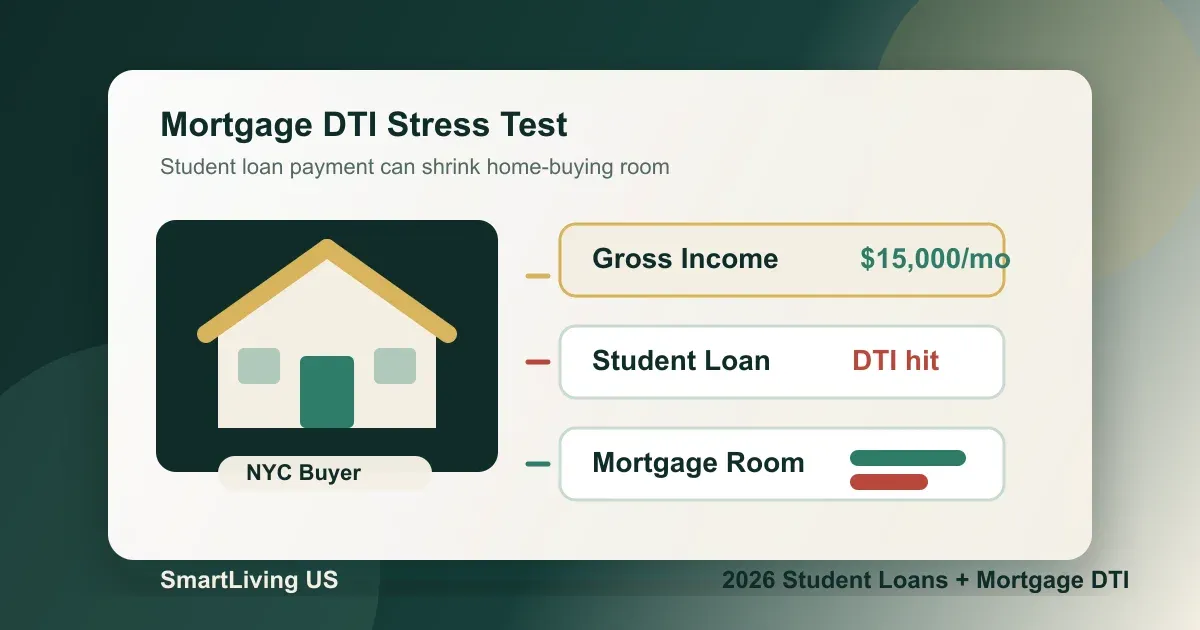
For a simple illustration, assume gross annual income is $180,000.
That is $15,000 per month before taxes.
If a certain mortgage scenario leaves room for total monthly debts equal to 45% of gross monthly income, the monthly debt room is $6,750.
That is only an illustration, not an approval rule.
Now assume the borrower has:
- Auto loan: $650
- Credit card minimums: $150
- Documented student loan payment: $350
That is $1,150 of non-housing monthly debt.
In this simplified example, about $5,600 remains for housing payment.
But if the underwriter cannot use $350 and must count the student loan at $1,200, the non-housing monthly debt becomes $2,000.
The housing room drops from about $5,600 to about $4,750.
That is an $850 monthly difference.
Use the mortgage calculator to see how an $850 monthly payment difference changes the home price you can realistically carry under different interest-rate, down-payment, tax, and insurance assumptions.
Step 2: Check What Payment Appears on Your Credit Report
Before applying, check how your student loan monthly payment appears on your credit report and student loan servicer statement.
Fannie Mae’s Selling Guide B3-6-05 says that if a monthly student loan payment is provided on the credit report, the lender may use that amount for qualifying. If the credit report does not show the correct monthly payment, the lender may use the payment shown on student loan documentation, such as the most recent student loan statement. Source: Fannie Mae Selling Guide B3-6-05, Monthly Debt Obligations
That is a practical lever.
You may not be stuck with a stale or incorrect credit-report payment if you can document the actual payment.
But the key word is document.
A verbal explanation is not the same as a loan file.
Prepare the servicer statement, repayment plan documentation, and payment schedule before the underwriter asks for them.
Step 3: If You Are on IDR, Prove the Actual Monthly Payment
If you are on income-driven repayment, do not just tell the lender you are on IDR.
Show the payment.
Federal Student Aid explains that income-driven repayment plans base the monthly payment on income and family size. Source: Federal Student Aid, Top FAQs About Income-Driven Repayment Plans
Fannie Mae’s treatment of IDR is especially important when the credit report has no payment or shows $0. Fannie Mae allows the lender, when the borrower is on an income-driven payment plan, to obtain student loan documentation verifying that the actual monthly payment is $0 and then qualify the borrower with a $0 payment.
Again, the document matters.
Not the story.
Not the screenshot from a random forum.
The file needs acceptable student loan documentation.
Step 4: If the Loan Is Deferred or in Forbearance, Ask About Balance-Based Calculations
If the student loan has no clear monthly payment or is in deferment or forbearance, ask the lender how that loan program calculates the qualifying payment.
For Fannie Mae, if the credit report does not provide a student loan payment or shows $0, the lender must determine a qualifying monthly payment. For deferred loans or loans in forbearance, Fannie Mae permits a payment equal to 1% of the outstanding student loan balance or a fully amortizing payment based on documented repayment terms.
FHA has its own rule set. HUD’s Mortgagee Letter 2021-13 says outstanding student loans must be included in liabilities. When the payment is above zero, FHA can use the credit-report payment or actual documented payment. When the monthly payment reported on the credit report is zero, FHA uses 0.5% of the outstanding loan balance. Sources: HUD Mortgagee Letter 2021-13 and HUD FHA Handbook 4000.1
This is why the same student loan can produce different DTI results under different programs.
Fannie Mae.
Freddie Mac.
FHA.
VA.
Jumbo.
Portfolio loans.
Each may treat the file differently.
So ask a more precise question:
For this specific loan program, will you count my student loan using the credit report, servicer documentation, IDR documentation, a balance-based percentage, or another documented repayment term?
That question is much more useful than sending another listing from Zillow.
Step 5: NYC Buyers Should Leave DTI Breathing Room
In New York City, qualifying at the edge is not a great personal-finance strategy.
The housing payment can be messy.
Condo common charges can rise.
Co-op maintenance can rise.
Property tax can change.
Insurance can change.
Assessments can appear.
If you are buying a co-op, the board package may also look at liquidity, post-closing reserves, housing ratio, and overall financial strength.
So this guide is not telling you to push DTI to the limit.
The SmartLiving rule is simpler.
Calculate first.
Then decide.
Start with the mortgage calculator, then put student loans, auto loans, credit card minimums, and personal loans back into the DTI picture. If you want a plain-English explanation of the calculator, read the mortgage calculator guide.
If your cash cushion is thin or you are carrying high-interest debt, read this first: Debt Payoff or Emergency Fund First?
Buying a home is not one number.
It is your entire cash-flow table under stress.
Step 6: Prepare These Documents Before Pre-Approval
Gather the student loan documents before a lender asks for them.
- [ ] Recent student loan servicer statement.
- [ ] Current repayment plan name and monthly payment.
- [ ] IDR documentation showing the actual monthly payment, if applicable.
- [ ] Credit report payment amount for each student loan.
- [ ] Written explanation from the lender on how the program treats $0, deferred, or forbearance payments.
- [ ] Conservative housing payment estimate from the mortgage calculator.
- [ ] List of all other monthly debt payments, including auto loans, credit card minimums, personal loans, and co-signed debts.
This checklist is not exciting.
But it can prevent an ugly surprise.
The bad version of this story is simple: you find the apartment, pay application fees, pay the attorney, start moving emotionally, and then the underwriter counts your student loan differently than you expected.
At that point, everything is harder.
The Bottom Line
Student loans do not automatically block a mortgage.
But the monthly payment calculation can change how much home you can carry.
This is especially important for high-income borrowers.
You may not be afraid of the balance.
But mortgage underwriting cares about documented monthly obligations.
Before you apply, answer three questions.
What monthly student loan payment appears on the credit report?
Can your servicer document the actual monthly payment?
How will the specific loan program count the payment in DTI?
Once those answers are clear, the mortgage calculator becomes useful.
Before that, you may only be calculating a wish.
Not the cash flow a lender will underwrite.
Sources
- CFPB: What is a debt-to-income ratio?
- Fannie Mae: Selling Guide B3-6-05, Monthly Debt Obligations
- HUD: Mortgagee Letter 2021-13, Student Loan Payment Calculation of Monthly Obligation
- HUD: FHA Single Family Housing Policy Handbook 4000.1
- Federal Student Aid: Top FAQs About Income-Driven Repayment Plans
Disclaimer: This article is for educational and informational purposes only. It is not mortgage, legal, tax, or personal financial advice. Lender overlays, loan programs, automated underwriting systems, and borrower files can produce different results. Before applying, confirm current rules with your lender, mortgage broker, loan officer, servicer, and the applicable official underwriting guide.
Related Financial Decisions
Keep using the same cash-flow lens on related decisions.
HELOC vs Cash-Out Refinance in 2026: Should You Tap Home Equity?
Home values are up, but home equity is not free cash. A 2026 guide to comparing HELOCs, home equity loans, and cash-out refinancing through payment shock, tax rules, and household cash flow.
financeStudent Loan Default in 2026: Wage Garnishment Is Delayed, But Default Still Matters
A practical 2026 guide to federal student loan default, delayed involuntary collections, wage garnishment, Treasury offsets, rehabilitation, consolidation, and cash-flow triage using ED, StudentAid.gov, and CFPB sources.
finance2026 Property Tax Appeal Guide: When an Escrow Jump Is Worth Fighting
Your escrow rose because property tax went up. A 2026 guide to deciding whether a property tax appeal is worth it, what evidence you need, deadlines, and when escrow actually drops.
SmartLiving Tools
Keep running the numbers with free practical tools.