2026 Car-Buying Tax Rules: After the EV Credit, Is the New Auto Loan Interest Deduction Worth Anything?
The most dangerous phrase in a dealer finance office is not always a lie.
Sometimes it is just incomplete.
“This car has a tax benefit.”
In 2026, that sentence needs to be pulled apart carefully. There are two very different tax ideas floating around the car market.
One is the clean vehicle credit many EV shoppers remember, often discussed as a credit of up to $7,500.
The other is the new auto loan interest deduction created under the One Big Beautiful Bill Act.
Both sound like “car tax savings.”
They do not work the same way.
A tax credit directly reduces tax. A deduction reduces taxable income. That difference can turn a headline number into a much smaller real-world benefit.
The Short Answer
Treat any car tax benefit as a bonus, not the reason to buy the vehicle.
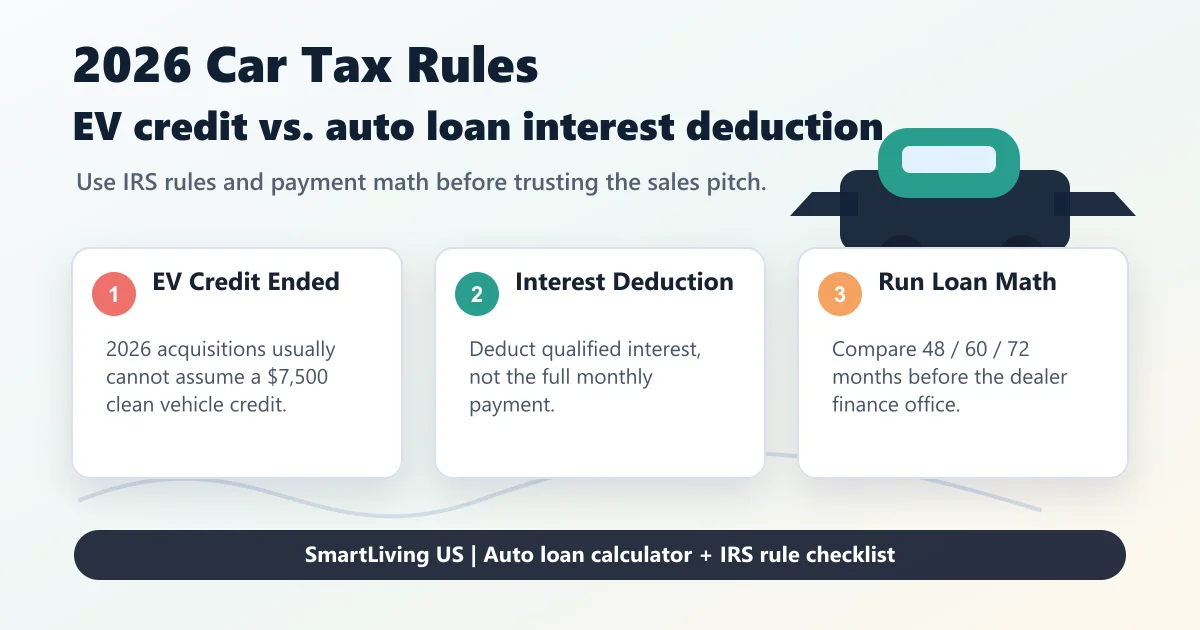
The IRS says on its Clean Vehicle Tax Credits page that clean vehicle credits are not available for vehicles acquired after September 30, 2025. For a typical vehicle acquired in 2026, the old EV-credit math should not be your starting point.
The new auto loan interest deduction can still matter, but it is narrower than many buyers may assume. IRS guidance says the deduction can apply from 2025 through 2028 for qualified interest on certain new vehicles, subject to limits, income phaseouts, personal-use rules, final assembly rules, and VIN reporting. Source: Treasury and IRS guidance on the new deduction for car loan interest.
So the useful question is not “does this car have a tax perk?”
The useful question is:
How much qualified interest will I actually pay, do I qualify after the income phaseout, and would this car still make sense with no tax benefit at all?
Step 1: Check Whether the EV Credit Is Already Off the Table
Start with the acquisition date, because clean vehicle credits generally do not apply after September 30, 2025.
That matters because much of the EV-buying conversation from 2023, 2024, and early 2025 is now stale for a 2026 buyer.
A shopper may still remember the old $7,500 number. A video may still mention it. A dealer may still talk broadly about “tax savings.”
But if you are acquiring the vehicle in 2026, do not build your budget around the old clean vehicle credit unless your tax professional or tax software confirms a specific transition rule applies to your exact facts.
This is especially important if the credit was the emotional reason you were willing to accept a higher price, higher insurance premium, or faster depreciation risk.
If the credit is gone, the entire worksheet changes.
For the charging and ownership side of the EV decision, see our practical guide: 2026 EV Buying Guide: Gas, Hybrid, or Electric When You Live in a Manhattan Apartment?
Step 2: Separate the Auto Loan Interest Deduction From a Tax Credit
The auto loan interest deduction reduces taxable income. It does not directly reduce the vehicle price.
That sentence is the whole game.
Suppose you pay about $2,900 of qualified car-loan interest in year one. If your marginal federal tax rate is 24%, the rough federal tax value is about $696.
Not $2,900.
Not $10,000.
Here is the clean distinction:
| Item | What it actually does | | --- | --- | | Clean vehicle tax credit | Directly reduces tax, but the credit ended for vehicles acquired after September 30, 2025 | | Auto loan interest deduction | Reduces taxable income if the loan and vehicle qualify | | Monthly payment | Principal plus interest, not fully deductible | | Annual cap | Up to $10,000 of qualified interest per year |
This is why “the interest is deductible” is not enough information.
You still need to know the actual interest amount, whether the vehicle qualifies, whether your income phases the deduction out, and what documents you will receive for tax filing.
Step 3: Check the Six Main Eligibility Gates
Use the eligibility rules first, because not every new car loan qualifies.
Based on IRS guidance and the proposed regulations, the main filters include:
- The loan must be incurred after December 31, 2024.
- The vehicle must be new, not used.
- The vehicle must be for personal use.
- The loan must be secured by a first lien on that vehicle.
- The vehicle must meet category and weight rules, such as a car, minivan, SUV, pickup truck, or motorcycle with a gross vehicle weight rating of no more than 14,000 pounds.
- Final assembly must occur in the United States, and the taxpayer must include the VIN on the tax return.
Final assembly is the trap many buyers will miss.
Do not assume based on brand. A model year, trim, plant, or VIN detail can matter. Before signing, cross-check the window sticker, manufacturer documents, dealer paperwork, and a public tool such as the NHTSA VIN Decoder.
Then check income.
IRS guidance says the deduction starts to phase out when modified adjusted gross income exceeds $100,000 for single filers or $200,000 for married filing jointly. The proposed regulations describe a reduction of $200 for each $1,000, or fraction of $1,000, above the threshold.
That means some high-income buyers may receive only part of the deduction, or none of it.
This is not a universal discount.
Step 4: Run a Real Loan Example Before You Sign
Use a simple example first: a $45,000 auto loan, 7% APR, and 60 months.
Under standard amortization, the monthly payment is about $891. The first year’s interest is about $2,903. Total interest over five years is about $8,463.
If the vehicle, loan, and taxpayer all qualify, the first-year deduction is roughly based on that $2,903 of interest, not the full $10,692 of annual payments.
| Marginal federal tax rate | Example first-year interest | Rough federal tax value | | --- | ---: | ---: | | 22% | $2,903 | About $639 | | 24% | $2,903 | About $697 | | 32% | $2,903 | About $929 |
This table is not a tax projection.
It is a scale check.
The new deduction may help, but it usually does not change the purchase price the way the old $7,500 EV credit could.
The better sequence is: vehicle price, APR, term, insurance, depreciation, cash flow, then tax benefit.
Before you sit in the finance office, run three versions in our auto loan calculator:
- Same car, 48 months vs. 60 months vs. 72 months.
- Same monthly payment, lower price vs. lower APR.
- No tax benefit at all, just the raw payment and total interest.
That third scenario is the honest one.
If the car only works after assuming a tax benefit, it may not really fit your cash flow.
Step 5: Do Not Mix Personal Car Rules, Business Car Rules, and Leasing
Personal auto loan interest, business vehicle deductions, Section 179, and leasing are separate tax frameworks.
This is where many online car-tax explanations become messy.
For a personal vehicle, the focus is the auto loan interest deduction, monthly payment, insurance, depreciation, and household cash flow.
For a business vehicle, you need to think about business-use percentage, depreciation, Section 179 limits, vehicle weight, records, commuting rules, and how your CPA treats mixed-use driving. IRS Publication 946 is the baseline source for depreciation and Section 179.
For a lease, the analysis changes again. You are looking at lease payments, mileage limits, residual value, early termination fees, and business-use treatment if the lease has a real business purpose.
Do not let all of these words blend into one vague promise that “it’s deductible.”
Tax rules are not magic.
They are conditions.
Step 6: Make a Three-Column Buying Worksheet
Put the car into three separate scenarios before you decide.
| Scenario | Numbers to check | Best use | | --- | --- | --- | | No tax benefit | Price, APR, payment, insurance, depreciation, total interest | Everyone should start here | | Qualified auto loan interest deduction | Interest paid, marginal rate, income phaseout, VIN, final assembly | 2026 new-car borrowers | | Business or self-employed vehicle | Business-use percentage, depreciation, Section 179, records | Real business-use cases |
The point is to remove the word “tax benefit” from the emotional part of the purchase.
You are not asking whether the car has a perk.
You are asking whether the car still makes sense in the conservative case.
Car-Buying Checklist for 2026
- [ ] Confirm the acquisition date. Do not assume a clean vehicle credit for a 2026 acquisition.
- [ ] Run the payment and total interest before focusing on tax benefits.
- [ ] Confirm the loan was incurred after December 31, 2024 and is secured by a first lien on the vehicle.
- [ ] Confirm the vehicle is new, personal-use, and has a GVWR of no more than 14,000 pounds.
- [ ] Check final assembly using the VIN, window sticker, manufacturer documents, or an official lookup tool.
- [ ] Estimate whether your modified adjusted gross income is above the $100,000 single or $200,000 married-filing-jointly phaseout threshold.
- [ ] Keep the purchase contract, loan documents, VIN, interest statement, and dealer tax documents.
- [ ] If the vehicle is used for business, leasing, or mixed personal and business use, ask a CPA before relying on a simple internet rule.
Bottom Line
The 2026 car tax rules are useful, but they do not change the basic order of operations.
An auto loan is a cash-flow decision first.
A tax decision second.
If the vehicle is too expensive without the tax benefit, the deduction is probably not enough to save the deal.
If the vehicle already fits your budget, has a reasonable APR, and does not create insurance or depreciation shock, the deduction can be a nice extra.
That is the cleaner order.
Run the car.
Then run the tax.
Not the other way around.
Sources
- IRS: Clean Vehicle Tax Credits
- IRS: Treasury and IRS provide guidance on the new deduction for car loan interest
- IRS: One Big Beautiful Bill provisions for individuals and workers
- IRS: Publication 946, How To Depreciate Property
- NHTSA: VIN Decoder
Disclaimer: This article is for educational and informational purposes only. It is not tax, legal, investment, or personal financial advice. Auto loan interest deductions, clean vehicle credits, business vehicle deductions, Section 179 treatment, and state-tax results depend on your documents, income, filing status, vehicle, use pattern, and current law. Consult a CPA or qualified tax professional before making a purchase or filing decision.
Related Financial Decisions
Keep using the same cash-flow lens on related decisions.
2026 Trump Account Guide: The $1,000 Child Savings Account vs. a 529 Plan
Trump Accounts are live. This 2026 family finance guide explains who may qualify for the $1,000 federal contribution, whether parents should add more money, and how Trump Accounts compare with 529 plans.
finance2026 Property Tax Appeal Guide: When an Escrow Jump Is Worth Fighting
Your escrow rose because property tax went up. A 2026 guide to deciding whether a property tax appeal is worth it, what evidence you need, deadlines, and when escrow actually drops.
financeStablecoins Are Not Bank Deposits: 7 Checks Before Treating USDC or USDT Like Cash in 2026
A practical 2026 guide to stablecoins, FDIC insurance, redemption risk, platform balances, taxes, scams, and when a stablecoin should or should not be treated like cash.
SmartLiving Tools
Keep running the numbers with free practical tools.