Are Smart Pet Devices Worth It? Smart Litter Boxes, Pet Cameras, GPS Collars, and Cost-Smart Choices
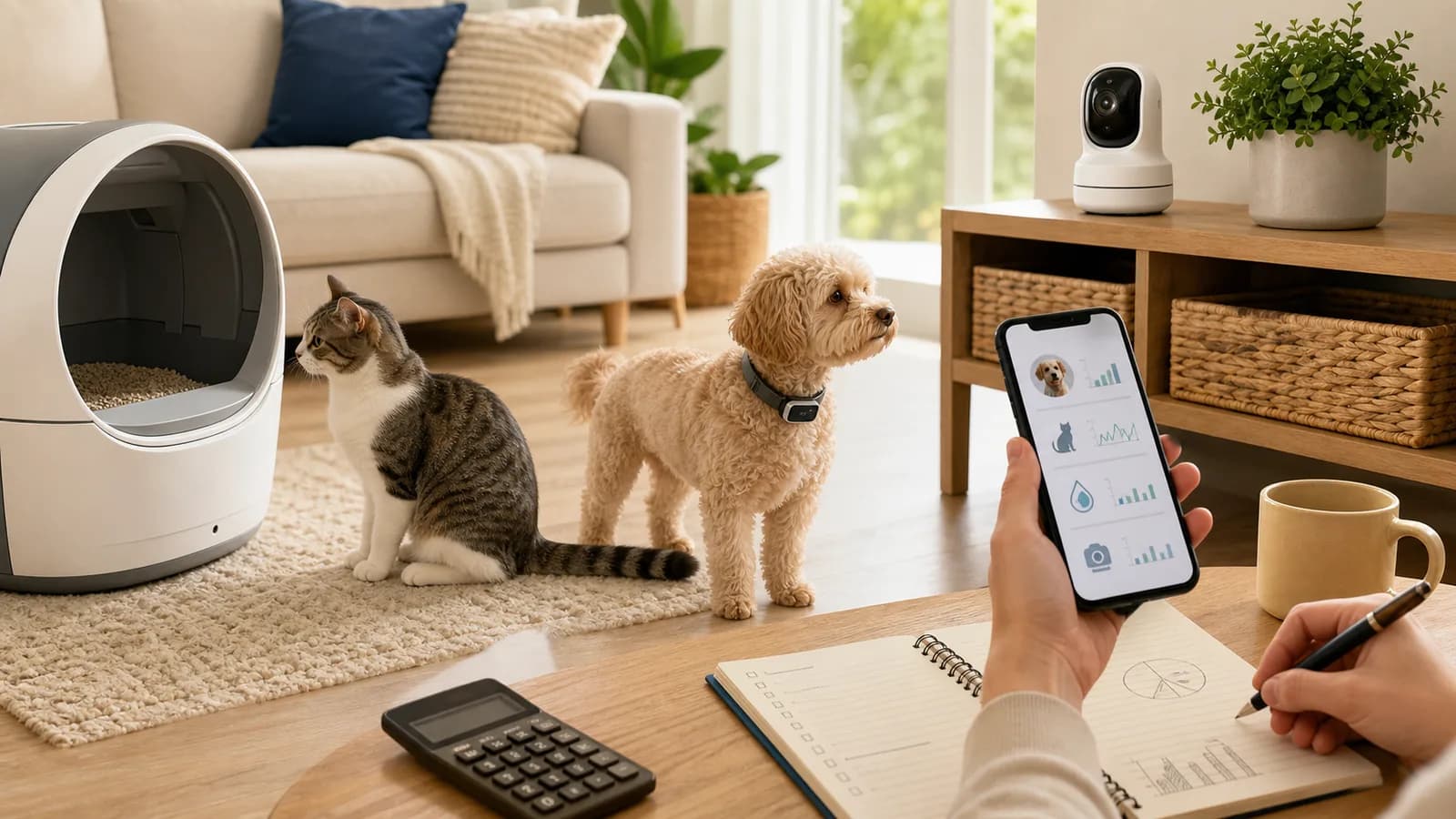
Smart pet devices often sell something more powerful than convenience.
They sell peace of mind.
You are at work, and your phone tells you your cat has used the litter box eight times today.
You are standing in line at the grocery store, and your pet camera sends a clip of your dog barking by the front door.
You open a GPS collar app and see that the dog who treats every open gate like a personal invitation is at least visible as a moving dot on a map.
That kind of information can feel comforting. It can also become expensive very quickly.
A smart litter box may cost several hundred dollars. A GPS collar may come with a device price plus a monthly plan. A pet camera may look cheap at first, then add cloud video, extra cameras, storage, and privacy decisions. Smart feeders and fountains may require filters, replacement parts, cleaning time, and a backup plan for power or Wi-Fi outages.
This guide is not a brand ranking. It is not here to tell you that every pet household needs more gadgets.
The better question is simpler: will this device help you take a better action, or will it only turn your anxiety into another subscription?
The basic test: does the device change what you do?
Before buying any smart pet device, ask one question:
Will this help me act earlier, more accurately, more safely, or with less waste?
If the answer is yes, the device may be worth considering.
If the answer is mostly "it will make me check an app more often," slow down.
The 2021 AAHA/AVMA Telehealth Guidelines for Small-Animal Practice discuss connected care, telemonitoring, video, remote data, and wearable technology as tools that may support communication and monitoring. The important word is support. A device can help collect information. It does not replace a veterinarian, an exam, lab work, imaging, or professional judgment.
The FDA's page on how it regulates animal devices is also a useful reminder. FDA has oversight of animal devices, but many devices intended for animal use do not require pre-market approval, and manufacturers or distributors are responsible for making sure those devices are safe, effective, and properly labeled.
In plain English: do not read "health monitoring," "trend analysis," or "abnormality alert" as a diagnosis.
Think of most smart pet devices as record keepers.
They can record when your cat used the litter box.
They can record when your dog barked.
They can record location, movement, feeding times, or water patterns.
That can be genuinely useful, but only if you know what you will do with the information.
Smart litter boxes: the trend data matters more than the gadget feeling
Smart litter boxes usually get attention because they scoop automatically.
That part can be helpful, especially in a multi-cat home, during long workdays, or when you travel for a short stretch.
But the health value is not the robot part. It is the trend data.
Useful questions include:
Has your cat's litter box frequency changed?
Are visits suddenly longer or more frequent?
Is your cat's weight trending down?
In a multi-cat home, can the device actually tell which cat is using the box?
If the data is reasonably accurate, it may help you notice changes earlier. That matters because cats are very good at hiding discomfort. A cat with a urinary problem may not look dramatic at first. You may only see more frequent litter box trips, straining, smaller urine clumps, accidents outside the box, hiding, low energy, or unusual vocalizing.
That is where a smart litter box can be helpful.
But the boundary matters.
A smart litter box cannot diagnose a urinary blockage.
It cannot diagnose kidney disease.
It cannot diagnose diabetes.
It cannot replace a urinalysis, blood work, imaging, or a veterinarian's judgment.
If your cat is repeatedly going to the litter box, straining, crying, licking the genital area, acting weak, vomiting, hiding, or seeming unable to urinate, especially if the cat is male, do not wait to see what the app says tomorrow. Contact your veterinarian or an emergency animal hospital.
For the cost and triage logic behind litter box changes, see our guide: Cat Peeing Outside the Litter Box? Rule Out Urinary Trouble Before Blaming Behavior.
So is a smart litter box worth it?
It depends on what you are buying.
If you are buying less scooping, it is a convenience tool.
If you are buying trend visibility, it is a record-keeping tool.
If you are buying the idea that the device will handle medical judgment for you, it is the wrong purchase.
Pet cameras: useful behavior data, real privacy cost
Pet cameras are easy to love because the feedback is immediate.
You open your phone and see where your dog is, whether your cat is sleeping on the couch, whether anyone is barking, pacing, scratching, or getting into trouble.
For dogs with possible separation anxiety, a camera can be genuinely useful. It can show whether barking starts five minutes after you leave or two hours later. It can show whether your dog is panicking at the door, reacting to hallway noise, pacing, drooling, or mostly bored. That information can make training conversations much more specific.
We use the same practical idea in our guide to dog separation anxiety, training, daycare, and care costs: seeing when and how the behavior happens can help you avoid guessing.
But a pet camera is not just looking at your pet.
It is looking at your home.
It may capture your living room, bedroom, children's spaces, daily schedule, visitors, whether someone is home, and when the house is empty.
The FTC's guidance on securing internet-connected devices at home recommends protecting both your router and individual devices. That includes changing default usernames and passwords, using encryption, checking for updates, using two-factor authentication when available, setting up security features, and disabling features you do not use.
The FTC's page on securing home security cameras is even more direct for cameras. Before you buy, look for security features such as encrypted livestreams and archived videos. Use strong unique passwords, avoid default credentials, keep software updated, consider whether remote viewing can be disabled, and be careful about sharing camera access with other people.
That is the hidden cost of a pet camera.
It is not only the price tag.
It is whether you are comfortable putting an internet-connected camera inside your home.
Before buying one, ask:
Can I turn off remote viewing?
Can I turn off the microphone?
Does the account support two-factor authentication?
Are livestreams and stored videos encrypted?
Can I turn off cloud recording?
Can I give a pet sitter limited access without giving full admin access?
How often does the app update?
If the company shuts down its service, will the device still work?
These questions are less fun than asking whether the camera can toss treats. They are also more important.
GPS collars: great for real escape risk, not a magic shield
GPS collars are most useful when a real lost-pet risk exists.
They may make sense for a dog who bolts through doors, a dog who hikes or camps with you, a newly adopted dog with weak recall, a pet under stress during travel or boarding, or a household where doors open often.
In those situations, the value is straightforward. A GPS collar cannot guarantee that you will recover a lost pet, but it may shorten the search and give you a direction when panic would otherwise take over.
Still, the limits are real.
Batteries die.
Location updates can lag.
Signal can be weaker indoors, around tall buildings, in parking garages, in dense trees, or in rural areas.
Monthly fees keep billing.
Some devices are too bulky for small pets.
Poor collar fit can create discomfort or safety problems.
A GPS collar is not a substitute for a microchip.
It is not a substitute for an ID tag.
It is not a substitute for a leash.
It is not a substitute for recall training.
It is one extra layer. That layer may be worth the money for high-risk pets. It may be unnecessary for a low-risk indoor cat or a dog who is always leashed and supervised.
Smart feeders and fountains: convenience is not the same as health management
Automatic feeders solve a specific problem: consistent feeding.
They can help if your work schedule changes, your cat wakes you up at dawn, your pet does better with smaller meals, or your household needs a way to stop accidental overfeeding by well-meaning humans.
But a feeder does not automatically create weight management.
If your pet is overweight, the key issues are total daily calories, measured portions, treats, shared household rules, and whether every person follows the plan. We cover that in more detail here: Why Pet Weight Loss Fails: A Practical Dog and Cat Weight-Loss Guide.
Smart fountains are similar.
Some pets drink more readily from moving water. That can be useful. But a fountain that is not cleaned well can become another maintenance chore with filters, pumps, seams, mineral buildup, and residue.
The real cost is not always the purchase price.
It is whether you will maintain the device.
Filters need replacement.
Pumps need cleaning.
Food hoppers need to stay dry.
Apps need updates.
Power and Wi-Fi outages need a backup plan.
If a device only feels elegant during the first week and then becomes another thing the household has to manage, it may not have reduced work. It may have changed the shape of the work.
A quick decision table
This is not a shopping list. It is a way to match the device to a real problem before spending money.
| Household situation | Device to consider first | Ask before buying | | --- | --- | --- | | Multi-cat home, concern about litter box changes | Smart litter box | Can it identify individual cats? Is the data accurate enough? Is cleaning manageable? | | Cat with urinary history or chronic health monitoring needs | Smart litter box, weight tracking | Will your veterinarian find the data useful? What will you do if the data changes? | | Dog may have separation anxiety | Pet camera | Do you need short-term observation or a permanent camera? Can you protect privacy? | | Dog bolts, hikes, travels, or spends time in changing environments | GPS collar | Are battery life, signal, monthly fees, weight, and collar safety acceptable? | | New pet family on a limited budget | Basic care first | Would this money be better used for exams, vaccines, parasite prevention, insurance, or an emergency fund? | | Feeding schedule is inconsistent | Automatic feeder, kitchen scale | Can you measure portions? Can the device prevent stealing or multi-pet food competition? |
My bias is conservative.
If the budget is tight, the first priority is usually not the most interesting gadget.
It is the care foundation: wellness exams, vaccines, parasite prevention, dental care, an emergency fund, and a realistic decision about pet insurance. For insurance math, see Is Pet Insurance Worth It for Cats and Dogs? What U.S. Pet Owners Should Check First.
Smart devices can be useful. They should not crowd out basic care.
The hidden costs people forget
Do not evaluate smart pet devices by the sticker price alone.
Look for the full one-year cost:
Device price.
Monthly subscription.
Cloud recording.
Location service.
Replacement filters.
Proprietary bags.
Parts and accessories.
Repairs.
Warranty terms.
App support.
Return policy.
There is also an anxiety cost.
You may buy a device to feel calmer, then end up checking more data every day.
Your cat drinks slightly less today, and you worry.
Your dog walks fewer steps, and you worry.
The camera shows your pet sleeping all afternoon, and you worry.
Some data helps you make decisions. Some data only pulls you into endless interpretation.
Before buying, decide what the data is for.
If the litter box app flags a change in urination, what will you do?
If the camera shows barking for 30 minutes, what training step comes next?
If GPS activity drops for several days, when will you contact the vet?
Data without an action plan is just anxiety in higher resolution.
When not to wait on a device
This part needs to be direct.
Smart devices can alert you. They cannot safely manage emergencies for you.
Do not wait at home watching app data if your pet has signs such as:
Repeated litter box trips with little or no urine.
Possible ingestion of medication, chocolate, grapes, xylitol, cleaners, or another toxic item.
Repeated vomiting or severe diarrhea.
Trouble breathing.
Seizures.
Obvious pain.
Severe lethargy.
Sudden weakness or trouble standing.
Trauma, bleeding, or being hit by a car.
In those situations, contact your veterinarian, an emergency animal hospital, or an animal poison control resource. For triage thinking and cost planning, see Pet Emergency Vet Bill Guide: Red, Yellow, and Green Signs for U.S. Dog and Cat Owners.
The best role for a smart device is to turn "something seems off" into "I have a record I can show my vet."
It should not turn "I should call the vet" into "I will wait and see what the app says."
How to spend less on the wrong device
Before buying, write down the real problem.
Not "I want a smart pet gadget."
Try:
"I want to know whether my cat's litter box habits are changing."
"I want to see whether my dog is distressed when alone."
"I am worried my dog might get lost."
"I want feeding to be more consistent."
The more specific the problem, the less likely you are to overspend.
Then calculate the first-year cost. Include the device, subscription, filters, bags, accessories, repairs, and any features locked behind a plan.
Finally, compare that total against other uses of the same money. Would it do more for your pet as an exam, dental care, training help, pet insurance, or emergency savings?
There is no universal answer. A GPS collar may be a smart purchase for one family and a waste for another. A pet camera may be a short-term training tool, not something you need forever. A smart litter box may be valuable in a multi-cat home and excessive in a one-cat household with a very attentive owner.
The point is not to reject technology.
The point is to make it earn its place.
Bottom line
Smart litter boxes, pet cameras, GPS collars, feeders, and fountains can be worth it when they solve a specific problem.
They are less useful when they mainly create more alerts, more fees, and more worry.
The best smart pet purchase gives you clearer records, earlier signals, better conversations with professionals, or safer routines. The worst one gives you another app to check while the actual care plan stays vague.
Smart pet care is not filling the house with connected devices.
It is knowing when technology helps, when to turn the screen off, and when to call the vet.
This article is for general pet care, consumer decision-making, and device safety education only. It is not veterinary diagnosis, treatment, training, legal, privacy/security, or personal financial advice. For pet health changes, suspected emergencies, ongoing behavior problems, medication questions, or treatment decisions, contact your veterinarian, a qualified behavior professional, an emergency animal hospital, or animal poison control. Before buying a connected camera, GPS collar, smart litter box, feeder, fountain, or other pet device, read the product label, privacy policy, subscription terms, return policy, and safety instructions.
Related Financial Decisions
Keep using the same cash-flow lens on related decisions.
Is Bad Breath Normal in Dogs and Cats? Pet Dental Care and Cleaning Costs
Bad breath in dogs and cats may point to plaque, tartar, gingivitis, periodontal disease, pain, or infection. Learn how brushing, VOHC products, anesthesia dental cleanings, and cost estimates fit together.
petHow to Choose Dog and Cat Food Without Overpaying: AAFCO and Label Basics
Pet food prices and marketing claims can be overwhelming. Learn how to read AAFCO statements, complete and balanced claims, life stages, calories, feeding directions, treats, toppers, and veterinary diets before paying more.
petWhy Pet Weight Loss Fails: A Cost-Smart Guide for Dogs and Cats
Dog and cat weight loss often fails because of hidden treats, loose measuring, family feeding habits, and missing vet follow-up. Learn how to avoid wasting money on ineffective products and build a safer plan.
SmartLiving Tools
Keep running the numbers with free practical tools.