Power Outage Food Spoilage Claim Guide 2026: Does Homeowners or Renters Insurance Pay?
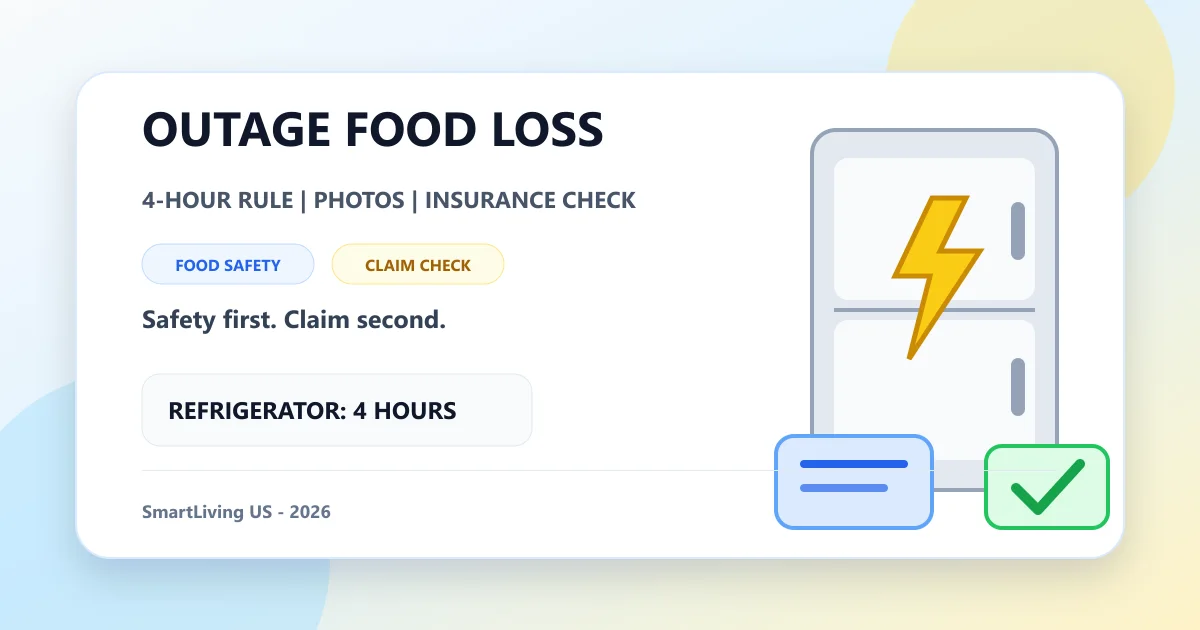
After a power outage, your refrigerator creates two separate questions: is the food safe, and is the loss worth an insurance claim?
Those are not the same question. The first is a food-safety decision. The second is a household finance decision. When storms, heat waves, grid failures, or hurricane-season outages knock out power, a refrigerator full of meat, seafood, dairy, eggs, leftovers, and frozen food can become a few hundred dollars of loss very quickly.
SmartLiving's view is simple: do not rush into a claim just because food spoiled. First decide what must be thrown away. Then check whether your homeowners or renters policy includes food spoilage coverage. After that, compare the possible payout with the deductible, your time, and the effect of adding another claim to your record.
This guide is not trying to negotiate with your insurer for you. It gives you the checklist to use before you call.
Step 1: Decide Food Safety Before You Think About Insurance
FoodSafety.gov explains, using USDA guidance, that a refrigerator can keep food safe for up to 4 hours during a power outage if the door stays closed as much as possible. After 4 hours without power, refrigerated perishable food such as meat, poultry, fish, eggs, and leftovers should generally be discarded. A full freezer can hold a safe temperature for about 48 hours, while a half-full freezer can hold it for about 24 hours if the door remains closed. Source: FoodSafety.gov Power Outage Chart.
CDC gives the same practical framework: keep refrigerator and freezer doors closed, remember the 4-hour refrigerator window, and never taste food to decide whether it is safe. Source: CDC Keep Food Safe After an Emergency.
That order matters. Do not taste questionable food because it was expensive. Do not assume food is safe because it smells normal. FDA also recommends preparing before outages with appliance thermometers, ice, coolers, gel packs, and a plan for keeping food at safe temperatures. Source: FDA Food and Water Safety During Power Outages and Floods.
Start with this safety checklist:
- Was the refrigerator without power for more than 4 hours?
- Did the refrigerator door stay closed?
- Was the refrigerator or food above 40°F?
- Does frozen food still contain ice crystals, or is it at 40°F or below?
- Did any food touch floodwater, stormwater, or unsafe water?
- Does anyone in the household have higher foodborne-illness risk, such as older adults, young children, pregnancy, or immune compromise?
If the safety answer is "discard," do not turn the grocery bill into a health gamble. Insurance comes later.
Step 2: Spoiled Food May Be Covered, But It Is Not Automatic
Some homeowners and renters policies may cover spoiled food after a power failure, but the details matter. The Texas Department of Insurance says some policies will pay up to $500 for spoiled food if power fails under certain circumstances, and it recommends calling your agent or company to ask whether your policy pays. Sometimes there may be no deductible. Source: Texas Department of Insurance: Power out, food spoiled?.
The key words are some policies and certain circumstances. One household may have a food spoilage endorsement. Another may not. One policy may treat utility interruption differently from storm-caused damage. One insurer may apply a deductible. Another may not.
Ask your agent or insurer these questions before you file:
- Does my homeowners or renters policy include food spoilage or refrigerated property coverage?
- Does it apply to utility power failure?
- Must the outage be caused by a covered peril such as wind, lightning, or storm damage?
- What is the per-event limit: $250, $500, or another amount?
- Is there a deductible?
- Will this be recorded as a claim in my history?
- What evidence do you need: photos, list, receipts, outage notice, or utility confirmation?
Once you have those answers, the decision becomes much cleaner.
Step 3: Photograph and List the Loss Before You Clean the Refrigerator
TDI's advice is plain: take pictures or keep a list of the food that spoiled. That small step can save you from relying on memory later.
Before throwing everything away, capture three types of evidence. First, photograph the refrigerator and freezer as a whole. Second, photograph the spoiled food, including packaging, brands, quantities, and any visible labels. Third, save outage evidence such as utility texts, outage-map screenshots, building notices, local alerts, or news updates.
Then make a simple list:
- date and approximate outage window
- food item
- quantity
- estimated price
- whether you have a receipt, store account record, or credit-card record
- whether the item was discarded
Do not keep unsafe food sitting around just to prove a claim. Photos, a list, and receipts are more useful than a bag of spoiled meat in your kitchen.
Step 4: The Deductible Can Make a Small Claim Irrational
NAIC's consumer homeowners insurance guide explains that the deductible is the amount you pay out of pocket on each claim and that you should be comfortable paying it if you make a claim. Source: NAIC Consumer Homeowners Insurance.
That matters a lot for food spoilage. If your refrigerator loss is $380 and your policy has a $500 deductible, the claim probably does not make financial sense. If the policy has a $500 food spoilage limit and no deductible, it may be worth asking about. If the deductible is $250, a $380 loss might technically produce a small payout, but you still need to consider the time involved and whether you want another claim on record.
Use this rough decision table:
| Estimated food loss | Deductible / limit | Practical direction | | :--- | :--- | :--- | | $100-$200 | Any meaningful deductible | Usually not worth a formal claim | | $300-$600 | No deductible or specific food-spoilage limit | Worth asking before filing | | $700+ | Clear coverage and good evidence | Worth evaluating seriously | | Food loss plus home damage | Part of a larger covered loss | Evaluate as part of the broader claim |
This is not insurance advice. It is a household cash-flow filter. The goal is to avoid creating a formal claim for a tiny net benefit.
If your homeowners insurance premium or escrow payment has already been rising, pair this with SmartLiving's Homeowners Insurance Premium Audit Guide 2026. Insurance is not only about whether a loss can be claimed. It is also about future renewals, deductibles, and coverage gaps.
Step 5: Homeowners, Renters, and Condo Owners Have Different Questions
Homeowners usually start with the homeowners policy. Renters start with renters insurance. Condo and co-op owners may need to separate the building master policy from their personal policy. Spoiled food is usually a personal property or special food spoilage question, not the same thing as structural damage.
Renters should not ignore this issue. Renters insurance is designed to protect personal belongings and, in some cases, additional living expenses. Whether spoiled food is covered depends on the policy, but renters are not outside the conversation.
Homeowners need to look one layer deeper. Was this only food spoilage, or did the same outage come with roof damage, tree damage, water backup, flooding, appliance damage, or loss of use? A refrigerator claim by itself may be small. A broader storm claim is a different financial decision.
For a wider storm-preparation view, see SmartLiving's 2026 Hurricane Season Money Checklist. Storms, floods, and power outages often overlap, and the money problems stack up quickly.
Step 6: When Not to File the Claim
Sometimes the smartest move is to document the loss, clean up, restock, and move on.
If the loss is below the deductible, do not file. If you cannot document the outage, food items, or estimated value, do not rush. If you have had multiple homeowners or renters claims in recent years, ask your agent about the possible effect before adding another one. If the loss is only $80 of refrigerated food, the time cost of the claim process may be larger than the payout.
But do not automatically give up either. If you had a full freezer, high-value food, a clear outage timeline, photos, receipts, and a policy with food spoilage coverage, asking questions is reasonable. Calling your agent is not the same as filing a claim.
Power Outage Food Spoilage Claim Checklist
- [ ] Do not taste questionable food.
- [ ] Record the approximate outage start and restoration time.
- [ ] Keep refrigerator and freezer doors closed as much as possible.
- [ ] After 4 hours, evaluate refrigerated perishables using official safety rules.
- [ ] Check whether frozen food still has ice crystals or is at 40°F or below.
- [ ] Photograph the refrigerator, freezer, spoiled food, packaging, and outage evidence.
- [ ] List food items, quantities, estimated value, and receipt sources.
- [ ] Check your homeowners or renters policy for food spoilage coverage.
- [ ] Ask about the coverage limit, deductible, and claim-history treatment.
- [ ] If the loss is small or below the deductible, consider not filing a formal claim.
- [ ] Clean the refrigerator and food-contact surfaces to prevent odor, mold, and further damage.
Final Takeaway
Power-outage food spoilage is not just a kitchen problem. It tests whether you know the food-safety rules, understand your insurance policy, and can stay calm around a small but annoying loss.
Use the right order: decide food safety first, document the loss second, check coverage third, and file only if the payout, deductible, evidence, and long-term insurance context make sense.
Disclaimer: This article is for general education, household financial-risk planning, and food-safety information only. It is not insurance, legal, medical, food-safety, tax, or personalized financial advice. Food safety, coverage, deductibles, claim-history treatment, policy limits, and state rules vary by household, insurer, policy, and location. Review official food-safety guidance and confirm your situation with your insurance agent, insurance company, state insurance department, or qualified professional before acting.
Related Financial Decisions
Keep using the same cash-flow lens on related decisions.
2026 Hurricane Season Money Checklist: Flood Insurance, Deductibles, Cash, and Documents
Hurricane preparation is not only water and flashlights. This 2026 checklist uses NOAA, FEMA, FloodSmart, and Ready.gov guidance to help households prepare insurance, cash, documents, and emergency records.
finance2026 PMI Cancellation Guide: When Can You Stop Paying Private Mortgage Insurance?
Private mortgage insurance is not always permanent. Use CFPB, Fannie Mae, Freddie Mac, and HUD rules to check 80% requests, 78% automatic termination, FHA MIP differences, and cash-flow math.
financeHomeowners Insurance Jumped in 2026? Audit Coverage Before Chasing the Cheapest Premium
A practical 2026 homeowners insurance audit for mortgage borrowers: escrow impact, deductibles, replacement cost vs. actual cash value, flood gaps, force-placed insurance, and cash-flow risk.
SmartLiving Tools
Keep running the numbers with free practical tools.