Solo 401(k) vs SEP IRA in 2026: Which Retirement Plan Fits a One-Person Business?
The most tempting sentence in one-person business tax planning is simple.
I am both the worker and the boss, so can I save more for retirement?
Often, yes.
But not casually.
If you are a freelance developer, Shopify seller, consultant, creator, contractor, or owner of a business with no common-law employees, a Solo 401(k) or SEP IRA can give you more retirement-plan flexibility than a standard employee-only 401(k) contribution.
But this is not tax magic.
A better way to think about it is this:
Solo 401(k)s and SEP IRAs are tax-advantaged retirement plans for small businesses. They can move part of your business income into a tax-deferred or Roth retirement structure, but only if you set up, fund, document, and report them correctly.
Used well, they can be powerful.
Used casually, they can create excess contributions, paperwork penalties, and tax problems that are much more annoying than the original tax bill.
Start With the 2026 Hard Limits
The IRS 2026 dollar-limit table lists the elective deferral limit for 401(k), 403(b), profit-sharing plans, and similar plans at $24,500. The age-50+ catch-up contribution is $8,000, and the defined contribution limit is $72,000. A higher catch-up limit of $11,250 applies for ages 60, 61, 62, and 63. Source: IRS COLA increases for dollar limitations
For SEP IRAs, the IRS says employer contributions cannot exceed the lesser of 25% of compensation or $72,000 for 2026. The same IRS page also notes that elective salary deferrals and catch-up contributions are not permitted in SEP plans. Source: IRS SEP contribution limits
For a one-participant 401(k), the IRS uses a very useful phrase: the business owner wears two hats. The owner can contribute as both employee and employer. Source: IRS One-participant 401(k) plans
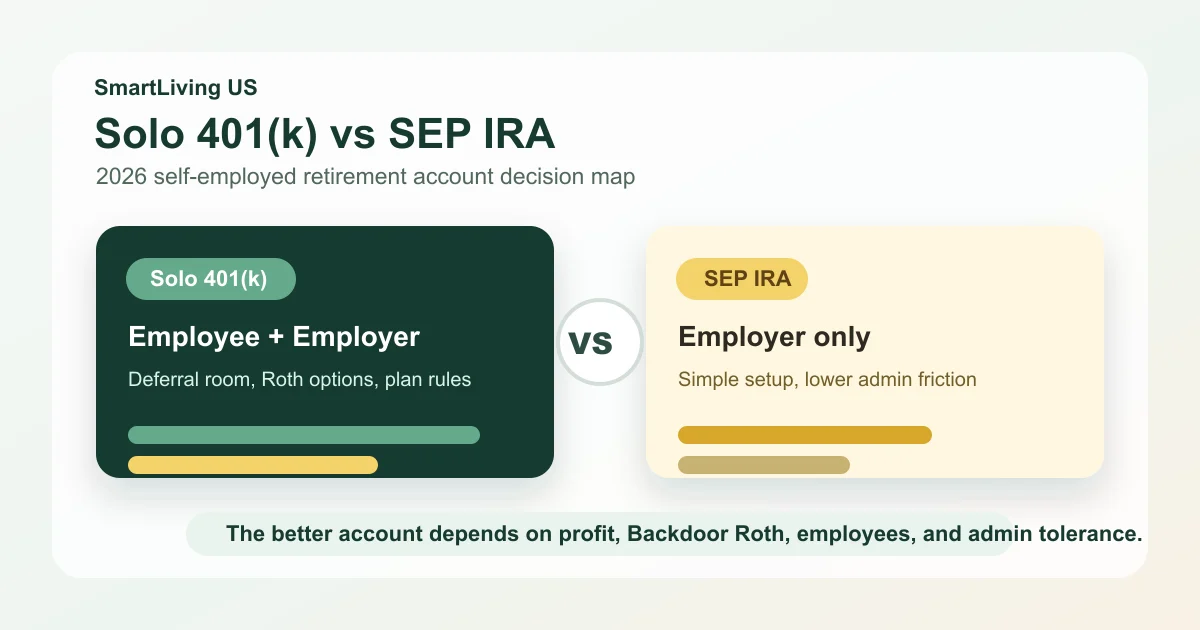
That is the core difference.
A SEP IRA is mostly employer-only.
A Solo 401(k) has employee deferral plus employer contribution.
The headline limit may look similar.
The path to reaching it is not.
At $100,000 of Self-Employment Profit, the Difference Can Be Large
Use a realistic small-business example.
Assume you are a sole proprietor or single-member LLC with about $100,000 of Schedule C net profit in 2026. You have no full-time employees and you have not elected S corporation payroll treatment.
Before doing any math, there is one important warning.
For self-employed people, employer contribution math is not simply $100,000 times 25%.
The IRS says self-employed individuals must make a special computation. For this purpose, compensation is earned income, defined as net earnings from self-employment after deducting both one-half of self-employment tax and contributions for yourself. The IRS points taxpayers to Publication 560 worksheets for the allowable contribution rate and deduction. Source: IRS One-participant 401(k) plans
That is why a Schedule C owner's employer contribution is often roughly closer to 20% of net earnings, not a simple 25% of gross net profit.
With $100,000 of self-employment profit, a rough planning example may look like this:
| Plan | Employee Deferral | Employer Contribution Rough Estimate | Rough Total | | --- | ---: | ---: | ---: | | SEP IRA | $0 | About $18,500 | About $18,500 | | Solo 401(k) | Up to $24,500 | About $18,500 | About $43,000 |
This is not a tax return.
Your actual number depends on business structure, self-employment tax, earned income, plan document terms, age, other retirement plans, and whether you operate as a sole proprietor, partnership, S corporation, or C corporation.
But the direction is clear.
At moderate profit levels, the Solo 401(k)'s employee deferral can matter a lot.
The SEP IRA does not have that employee-deferral layer.
So while it is simpler, it may leave meaningful retirement contribution room unused.
That is why this article fits the SmartLiving 401(k) cluster without duplicating the existing guides.
The earlier guide, How Much Should You Put in Your 401(k) in 2026?, is about regular 401(k) contribution rates, employer match, inflation, and future balance.
This guide is about one-person businesses and which small-business retirement plan structure fits the owner.
Different search intent.
Different reader problem.
If You Also Have a W-2 Job, Do Not Double Count the Employee Deferral
Many readers will not be purely self-employed.
They may have a W-2 job during the day and run a Shopify store, consulting business, software product, creator business, or other side company at night.
That is where the math gets dangerous.
The IRS reminds one-participant 401(k) owners that if they also work for another company and participate in that company's 401(k), the elective deferral limit is by person, not by plan.
Plain English:
If you already put the full $24,500 into your W-2 employer's 401(k) for 2026, you generally cannot make another $24,500 employee deferral into your Solo 401(k).
You may still have room for an employer contribution from the self-employed business.
But the employee deferral bucket is shared.
This is one of the most important details in side-business retirement planning.
The hard part is not memorizing the $24,500 number.
The hard part is knowing whether a limit applies per person, per employer, per plan, or per compensation source.
Get that boundary wrong, and the spreadsheet can look beautiful while the tax position is wrong.
Backdoor Roth IRA Users Should Be Careful With SEP IRA Balances
If you use the Backdoor Roth IRA strategy, a traditional SEP IRA can create a hidden problem.
The IRS Form 8606 instructions say that, unless otherwise stated, the term traditional IRA includes traditional SEP IRAs and traditional SIMPLE IRAs. The same instructions for line 6 tell taxpayers to enter the total value of all traditional IRAs as of December 31, plus outstanding rollovers. Source: IRS Instructions for Form 8606
That is the practical reason people worry about the pro-rata rule.
If you have a large pretax SEP IRA balance and then make a nondeductible traditional IRA contribution that you intend to convert to Roth, Form 8606 does not look only at the new after-tax contribution.
It looks at the broader traditional IRA pool.
That can turn what looked like a clean Backdoor Roth into a partially taxable Roth conversion.
A Solo 401(k) can be cleaner here because it is a qualified plan, not an IRA. A Solo 401(k) balance generally is not included on Form 8606 line 6 as a traditional IRA balance.
That does not automatically make Solo 401(k) the right answer for everyone.
But if keeping the Backdoor Roth path clean is important to you, a traditional SEP IRA deserves extra caution.
If you are still sorting out Roth versus Traditional tax timing, start here: Roth 401(k) vs Traditional 401(k): Which One Makes More Sense in 2026?
The Cost of a Solo 401(k) Is Real Plan Administration
If the Solo 401(k) is so flexible, why would anyone choose a SEP IRA?
Because a SEP IRA is simple.
It is usually straightforward to open, fund, and maintain.
A Solo 401(k) is more powerful, but it is still a retirement plan.
The IRS says a one-participant 401(k) plan is generally required to file Form 5500-EZ if it has $250,000 or more in assets at the end of the year. Source: IRS One-participant 401(k) plans
The IRS also states that penalties for late filing of Form 5500 series returns are $250 per day, up to $150,000 per plan year, for returns due after December 31, 2019. Source: IRS filing notices for Forms 5500
That is not a small paperwork mistake.
With a Solo 401(k), you need to understand the plan document.
Contribution deadlines.
Roth versus Traditional recordkeeping.
Whether the plan permits participant loans.
When Form 5500-EZ becomes required.
What happens if you hire eligible common-law employees.
That last point matters.
The IRS notes that the no-testing advantage of a one-participant 401(k) disappears if the business hires employees who meet plan eligibility requirements. At that point, the plan may need to include them and comply with nondiscrimination rules unless an exemption applies.
So the question is not, "Which plan is more advanced?"
The question is, "Is the extra contribution room, Backdoor Roth flexibility, and possible loan feature worth the administration?"
Who Should Look at Solo 401(k) First?
Here is the practical decision table.
| Situation | Plan to Research First | | --- | --- | | Self-employment profit is moderate and you want more contribution room | Solo 401(k) | | You want an employee deferral layer in addition to employer contribution | Solo 401(k) | | You use Backdoor Roth IRA and want to avoid pretax traditional IRA aggregation | Solo 401(k) | | You want a plan that may allow participant loans | Solo 401(k), if the plan document allows it | | You want the simplest setup and lowest ongoing administration | SEP IRA | | Profit is high enough that employer-only SEP contributions already meet your needs | SEP IRA can be reasonable | | You may hire employees soon and want less plan complexity at first | SEP IRA may be easier, but employee rules still matter | | You operate as an S corporation | Ask a CPA to model W-2 wages and employer contributions |
A SEP IRA is not a bad plan.
It is simpler and broader.
A Solo 401(k) is not a magic trick.
It is more flexible and more administrative.
For a one-person business, the right decision usually comes down to four things:
Profit level.
Backdoor Roth strategy.
Employee plans.
Administrative tolerance.
Use the Calculator for Compounding, Not for Tax Filing
In the $100,000 profit example, the most visible difference is that a Solo 401(k) may allow far more retirement contribution room than a SEP IRA at moderate income levels.
The bigger question is what that difference can become over time.
You can use the SmartLiving 2026 401(k) calculator to estimate how higher annual contributions might compound over 10, 20, or 30 years.
But be precise about what the tool does.
It is a regular 401(k) compounding and withdrawal-estimate calculator.
It is not a Solo 401(k) tax worksheet.
It will not calculate your self-employed contribution deduction.
It will not decide whether you need Form 5500-EZ.
It will not model Form 8606 pro-rata treatment.
It will not replace S corporation payroll planning.
Use it to understand the long-term power of saving more.
Use a CPA or qualified tax adviser to decide what you are allowed to contribute.
If you are also thinking about taking money out of a retirement account early, read this first: Thinking About Cashing Out Your 401(k)? Run the Tax and Penalty Math First
Sometimes the expensive mistake is not failing to contribute.
It is contributing aggressively without enough cash-flow planning, then being forced to withdraw early later.
A Simple Decision Sequence
If you run a one-person business and want to choose between Solo 401(k) and SEP IRA, I would not start with the maximum limit.
I would start here.
First, check whether you already used your employee deferral through a W-2 job.
Then identify your business tax structure: Schedule C, partnership, S corporation, C corporation, or something else.
Then decide whether Backdoor Roth IRA cleanliness matters.
Then decide whether you can handle Solo 401(k) plan documents, contribution tracking, and future Form 5500-EZ filing.
Only after that should you compare this year's contribution amount.
The order matters.
Retirement-account planning is not a contest to hit the biggest number.
It is tax planning, cash-flow planning, compliance, and compounding all sitting on top of each other.
Solo 401(k) and SEP IRA can both be good tools.
The right one is the one that fits your actual business.
Disclaimer: This article is for educational and informational purposes only. It is not investment, tax, legal, retirement-plan, or personal financial advice. Solo 401(k)s, SEP IRAs, self-employed contributions, S corporation wages, Backdoor Roth strategy, Form 8606, Form 5500-EZ, plan loans, employee coverage rules, and contribution deadlines can vary based on account type, business structure, income, age, plan documents, and future law changes. Before setting up or funding a plan, consult a CPA, tax adviser, retirement plan administrator, attorney, or qualified financial professional.
Related Financial Decisions
Keep using the same cash-flow lens on related decisions.
Thinking About Cashing Out Your 401(k)? Run the Tax and Penalty Math First
A 401(k) balance is not the same as spendable cash. This 2026 guide explains early distribution penalties, ordinary income tax, rollovers, hardship withdrawals, loans, and the real cost of cashing out before retirement.
financeHow Much Should You Put in Your 401(k) in 2026? Use a Calculator Before Guessing
A practical 2026 guide to choosing a 401(k) contribution rate using IRS limits, employer match, inflation-adjusted purchasing power, and a realistic New York withdrawal-tax estimate.
financeRoth 401(k) vs. Traditional 401(k) in 2026: A Practical Tax-Now or Tax-Later Guide
Choosing Roth or Traditional 401(k) is not about which account earns more. It is about when you pay taxes. Use 2026 IRS limits, tax brackets, employer match, state taxes, and cash flow to make a clearer decision.
SmartLiving Tools
Keep running the numbers with free practical tools.