2026 U.S. Credit Payment Options: Credit Cards, BNPL, Pay in 4, and Pay Monthly Compared
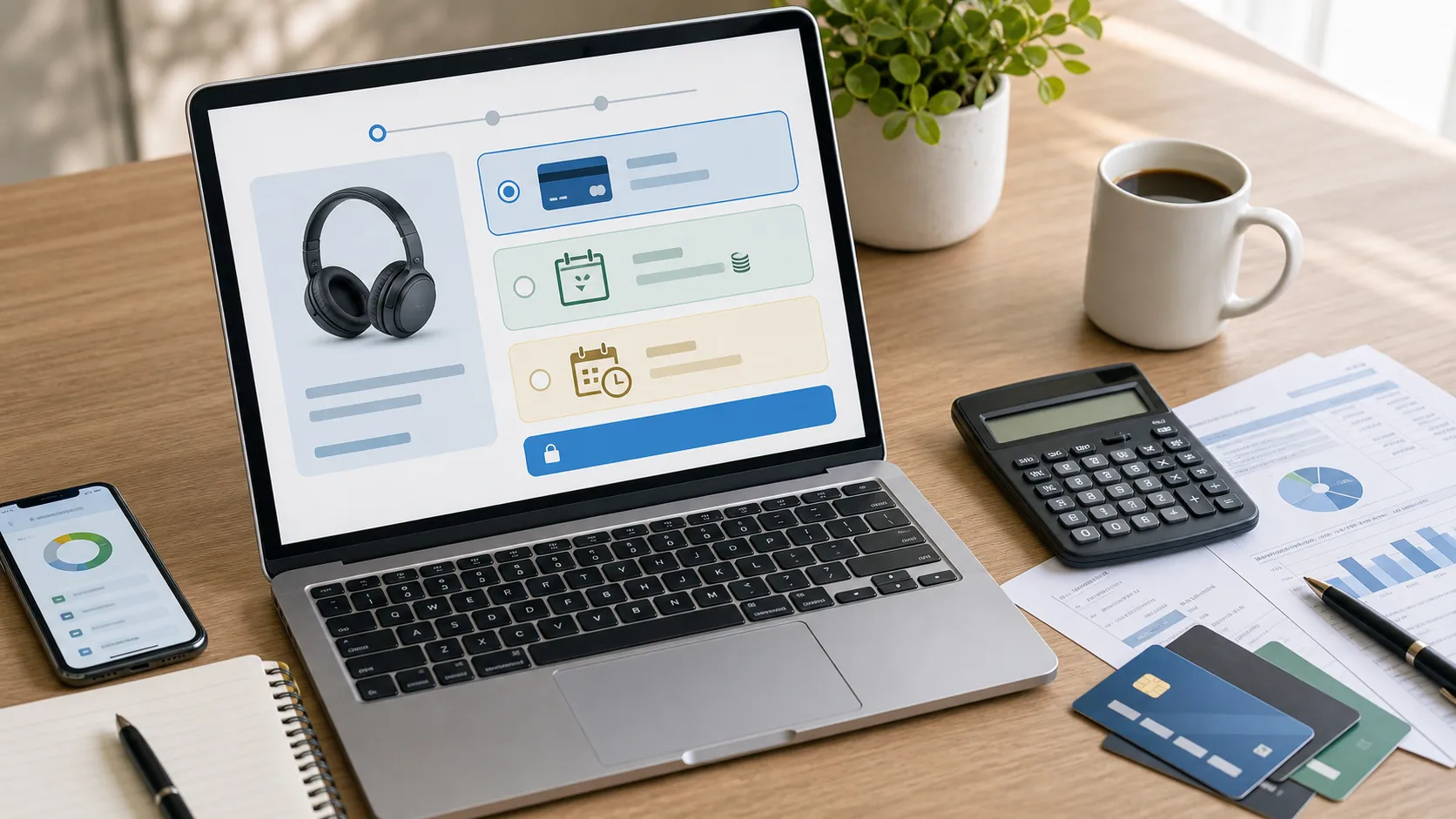
Online checkout in the U.S. used to be fairly simple. Most people chose between a credit card, debit card, or PayPal. Now the payment section may include Pay in 4, Pay Monthly, Buy Now Pay Later, installment financing, store financing, and other options that all sound similar.
They are not the same. Some are short-term and may be interest-free. Some are longer-term loans. Some charge service or origination fees. Some may affect credit more than others.
This guide is not a recommendation for any platform. It is a practical checklist for what to look at before clicking the payment button.
Start Here: 5 Common Ways to Pay With Credit
Most U.S. consumer credit payment options fall into five broad categories: traditional credit cards, short-term Pay in 4 plans, longer-term monthly financing, merchant-linked installment plans, and earned wage access.
The CFPB describes common Buy Now, Pay Later products as short-term installment loans used by consumers when buying retail goods, often structured as four interest-free payments. In other words, BNPL is not free money. It is a way to move one purchase into several future payment dates. Source: CFPB: The Buy Now, Pay Later Market
If you only care about cost, the safest rule is simple:
If you can pay in full every month, a credit card may be best for everyday spending because it can offer rewards, purchase protection, dispute rights, and credit history.
If you are certain you can repay within about six weeks and the checkout page shows zero interest and zero fees, Pay in 4 may be reasonable.
If repayment stretches over several months or years, treat it like a real loan and check the APR and total repayment amount.
If the product charges a service fee, origination fee, or other fixed fee, “no interest” does not mean “no cost.”
If your cash flow is already tight, BNPL or wage access may delay the problem instead of solving it.
Credit Cards: Useful, but Expensive If You Carry a Balance
Credit cards work best for people who pay the statement balance in full every month. Used that way, they can provide a grace period, rewards, purchase protection, fraud dispute support, and credit-building history. For many people in the U.S., a credit card is still an important credit-building tool.
The trouble starts when you carry a balance. FRED / Federal Reserve G.19 data shows that the average interest rate on commercial bank credit card plans was 21.00% in February 2026. At that level, interest can easily erase the value of points or cashback. Source: FRED TERMCBCCALLNS
So the question is not whether credit cards are good or bad. The question is whether you are using them for planned spending or as a cash flow patch.
Pay in 4: Simple, Short-Term, and Easy to Overuse
Pay in 4 usually means you pay part of the purchase today and the rest every two weeks, for a total of four payments. Many short-term Pay in 4 products advertise 0% APR or no interest.
For example, PayPal says Pay in 4 can be used for eligible purchases from $30 to $1,500. The purchase is split into four interest-free payments, with the first payment due at purchase and the remaining payments due every two weeks. PayPal also says Pay in 4 has no sign-up fee, application fee, late fee, or NSF fee, though your bank or card issuer may charge fees if a payment fails. Source: PayPal Pay in 4
The biggest Pay in 4 risk is not always one purchase. It is stacking. A $200 order split into four $50 payments may feel harmless. Five similar orders can turn into several hundred dollars of automatic payments next month.
Before using Pay in 4, check three things: whether total repayment equals the purchase price, whether payment dates are clear, and what happens if a payment fails.
Pay Monthly: Do Not Judge It by the Monthly Payment Alone
Pay Monthly is different from Pay in 4. Monthly financing usually lasts longer, such as 3, 6, 12, or 24 months. It can be useful for larger purchases, but it should be treated like a loan.
PayPal explains that Pay Monthly can split eligible purchases into fixed monthly payments over 3 to 24 months, with example fixed APRs from 9.99% to 35.99%, depending on purchase amount and credit. Source: PayPal Pay Later
Affirm also states that its Pay in 4 option is 0% APR, while other payment plans may have APRs from 0% to 36%, depending on credit, merchant, and purchase amount. Source: Affirm
The phrase “only $49 per month” is not enough information. The important numbers are APR, total interest, and total repayment. A low monthly payment over a long term can still be expensive.
Klarna, Afterpay, Zip, and Sezzle: Similar Labels, Different Costs
Klarna, Afterpay, Zip, and Sezzle are often grouped under BNPL, but the terms can vary by platform, product, merchant, purchase size, state, and eligibility.
Klarna offers payment options such as Pay in 4, Pay in 30 days, and other financing choices in the U.S. It can be convenient for retail purchases, but users should always confirm the exact repayment schedule, fees, and eligibility terms at checkout. Source: Klarna payments
Afterpay describes both Pay in 4 and longer-term payment plans in the U.S. A short-term four-payment plan and a longer installment plan are not the same cost structure, so users should review the APR, fees, and total payment shown at checkout. Source: Afterpay
Zip requires special attention to origination fees. Zip’s own example shows a $400 purchase split into four payments of $102 every two weeks, for a total of $408. That example includes an $8 origination fee and shows an example APR of 34.75%. Zip says actual origination fees vary by purchase price. Source: Zip: How it works
Sezzle also requires checking service fees. Sezzle’s example shows a $300 Pay in 4 purchase with total payments of $307.49, including a $7.49 service fee and an example APR of 45.0%. Actual fees are shown at checkout. Source: Sezzle
The lesson is simple: do not assume that “four payments” means “free.” The only reliable test is the total amount you will pay.
Will BNPL Affect Your Credit Score?
BNPL credit impact depends on the product. The CFPB explains that BNPL lenders usually do not perform a hard inquiry that affects credit scores when someone applies for BNPL. However, larger and longer-term installment loans may involve a hard inquiry and may report repayment history to credit reporting companies. Consumers should read the terms before applying and before accepting the loan. Source: CFPB: Will a BNPL loan impact my credit scores?
In plain English: short-term Pay in 4 may not help build credit the way a credit card can. But missed payments, collections, or longer-term financing can still create consequences. BNPL is not automatically invisible and risk-free.
Earned Wage Access: Helpful in a Pinch, Risky as a Habit
Earned Wage Access services are different from shopping installment plans. They may allow you to access part of wages you have already earned before payday. That can help with temporary cash flow, but it can also create a habit of spending next paycheck early.
For these services, check fast-transfer fees, membership fees, tip models, automatic repayment, and whether using the service will make the next payday tighter. It is not a credit card and not the same as BNPL, but it still moves cash flow from the future into today.
How to Choose More Safely
If you can pay in full every month, a credit card is often better for everyday spending because of rewards, protections, and credit history. The condition is that you do not carry a balance.
If you are splitting a small necessary purchase for a few weeks, Pay in 4 may be acceptable when the total cost is zero, payment dates are clear, and you are not stacking several orders.
If you are buying a larger item such as a computer, phone, furniture, or repair service, Pay Monthly is not automatically bad, but you must compare APR, total interest, and total repayment.
If a product has a service fee or origination fee, judge it by total repayment, not by the word “interest-free.”
If cash flow is already tight, start with budgeting, expense cuts, and high-interest debt reduction. Do not use installments to hide a problem until next month.
Bottom Line
In 2026, U.S. payment options are more flexible than ever, but the basic decision rule has not changed: look at total cost, not just monthly payment; look at APR, not just installment count; look at credit impact, not just approval speed.
A safer order often looks like this:
First, if you can pay in full, use a credit card for rewards and protections.
Second, if you can repay within about six weeks, consider 0% Pay in 4.
Third, for necessary large purchases, compare Pay Monthly, promotional credit card APRs, personal loans, and cash payment.
Fourth, if there is a service fee or origination fee, judge by total repayment.
Fifth, if cash flow is tight, fix the budget first instead of using installment plans to cover routine spending.
This article is for general financial education only and is not loan, credit, investment, tax, or legal advice. Platform rates, eligibility, APRs, state availability, and merchant restrictions can change. Always rely on the checkout page, loan agreement, and official terms before using any payment product.
Related Financial Decisions
Keep using the same cash-flow lens on related decisions.
Student Loans and Mortgage DTI in 2026: What NYC Buyers Should Check Before Applying
Student loan debt does not automatically block a mortgage. The real issue is how the monthly student loan payment is counted in DTI. This guide uses CFPB, Fannie Mae, HUD/FHA, and StudentAid.gov sources to build a practical pre-approval checklist.
financeStudent Loan Default in 2026: Wage Garnishment Is Delayed, But Default Still Matters
A practical 2026 guide to federal student loan default, delayed involuntary collections, wage garnishment, Treasury offsets, rehabilitation, consolidation, and cash-flow triage using ED, StudentAid.gov, and CFPB sources.
financeShould You Click Buy Now, Pay Later at Checkout? Watch These 4 Hidden Costs
Buy Now, Pay Later can look interest-free and convenient, but it may create late fees, overspending, credit reporting issues, and cash flow pressure. This guide uses CFPB and Richmond Fed sources.
SmartLiving Tools
Keep running the numbers with free practical tools.