Is Bad Breath Normal in Dogs and Cats? Pet Dental Care and Cleaning Costs
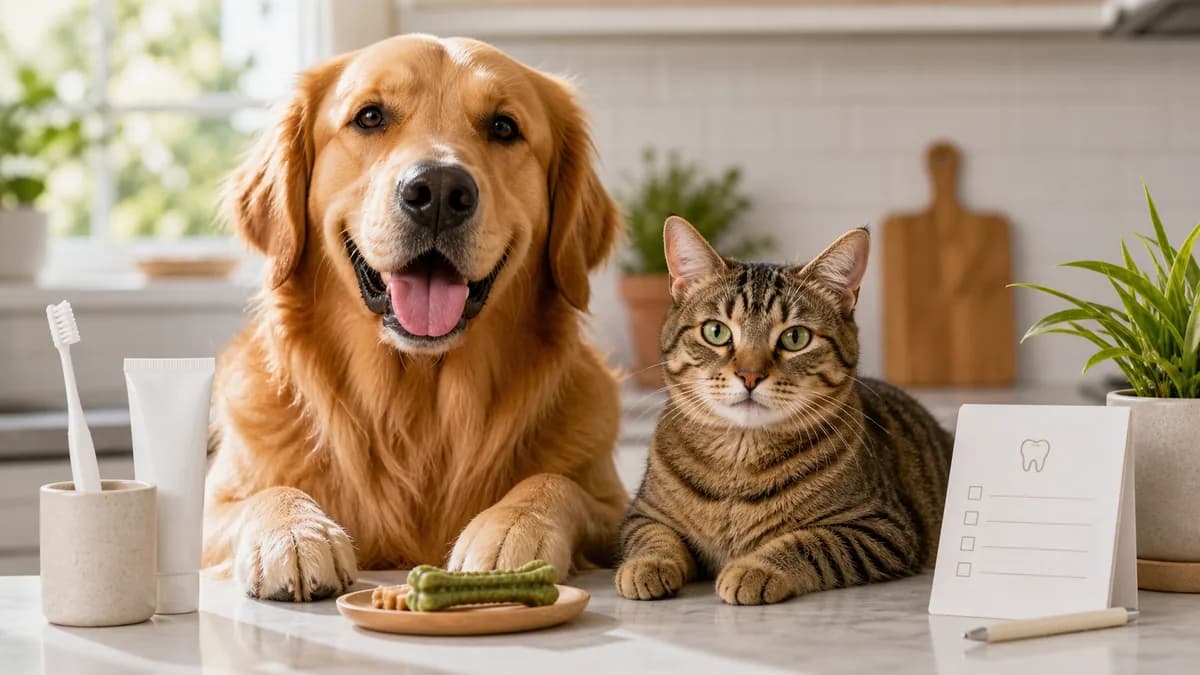
Many pet owners first notice dental disease by smell.
Your dog leans in for a kiss.
Your cat yawns near your face.
For one second, your brain goes blank.
Then the thought lands.
Why does that smell so bad?
It is tempting to explain it away. Dogs have dog breath. Cats eat meat. Pets are not supposed to smell minty.
That is partly true.
Your pet's mouth does not need to smell like toothpaste.
But strong, worsening, or unusual bad breath should not be treated as automatically normal, especially if it comes with red gums, tartar, drooling, dropped food, chewing on one side, pawing at the mouth, facial swelling, or a sudden dislike of hard food.
Dental disease hides well.
By the time people smell it, see it, or worry about it, the problem may not be new.
Bad Breath Is Not a Diagnosis
Bad breath does not tell you exactly what is wrong.
It cannot diagnose gingivitis, periodontal disease, a broken tooth, an oral mass, kidney disease, diabetes, or food trapped around the teeth.
But it is a signal.
AVMA's pet dental brochure describes periodontal disease as one of the most common dental conditions in dogs and cats and notes that many pets are likely to have early evidence by age 3. It also recommends a veterinary check if you notice bad breath, broken or loose teeth, tartar, abnormal chewing, drooling, dropped food, reduced appetite, mouth pain, bleeding, or swelling around the mouth. Source: AVMA: Periodontal Disease in Pets
Age 3 surprises a lot of people.
It sounds young.
But plaque, tartar, gingivitis, and periodontal disease do not wait until a pet looks old.
So do not treat bad breath as proof of one specific problem.
Treat it as a reason to look closer.
More accurately, treat it as a reason for your veterinarian to look closer.
White Teeth Do Not Always Mean a Healthy Mouth
This is the part many owners miss.
We tend to judge teeth by what we can see.
Are the visible surfaces white?
Is there brown tartar?
Does the smile look okay?
But periodontal disease often matters most below the gumline. Plaque, tartar, pockets, bone loss, infected roots, and painful teeth can hide where a quick home inspection cannot see.
AAHA's pet dental care materials explain that by age 3, most dogs and cats have some form of periodontal disease. They also stress that without anesthesia, veterinarians cannot fully evaluate and treat dental health, including areas below the gumline. Source: AAHA: Dog & cat dental disease
The question is not only whether the visible tooth surface can be scraped clean.
The question is what is happening under the gumline.
That is why a pet may seem to have only bad breath, but dental X-rays reveal root problems, resorptive lesions, bone loss, fractured teeth, or teeth that need extraction.
That sounds scary.
But it is not meant as fearmongering.
It is a reminder that the mouth is more than the part you can see.
Brushing Is Still the Boring Best Habit
The least glamorous dental habit is still the one worth practicing.
Brushing.
I know.
Many pets do not exactly volunteer for it.
You pick up the toothbrush and your dog looks betrayed.
You lift your cat's lip and the relationship immediately becomes complicated.
You touch one tooth and everyone in the room reconsiders their life choices.
Still, brushing is worth training.
AAHA's dental care guidelines for dogs and cats include home oral hygiene as part of dental health management and emphasize owner education and ongoing care. Source: AAHA: 2019 Dental Care Guidelines for Dogs and Cats
The practical approach is not to brush the entire mouth on day one.
Let your pet lick pet-safe toothpaste.
Practice touching the lips.
Touch the outside of a tooth with your finger, gauze, or a finger brush.
Gradually introduce a soft toothbrush.
Even 10 to 20 calm seconds can be a start.
Brushing the outside surfaces is better than doing nothing.
The point is not to win a wrestling match. The point is to slowly build tolerance.
Use toothpaste made for pets, not human toothpaste. Human toothpaste is not designed to be swallowed by dogs or cats, and some ingredients are not appropriate for pets.
VOHC Products Can Help, But They Are Not Magic
When brushing feels impossible, owners start looking for help.
Dental chews.
Dental diets.
Water additives.
Wipes.
Sprays.
That makes sense.
A useful filter is VOHC, the Veterinary Oral Health Council.
VOHC maintains accepted product lists for dogs and cats. Products may include dental diets, chews, water additives, toothbrushes, wipes, and other dental care items that have met VOHC's standards for helping control plaque or tartar. Source: VOHC: Accepted Products
A VOHC seal does not mean a product is right for every pet.
It does not mean brushing is unnecessary.
It does not treat advanced periodontal disease.
But it does mean the product has some evidence behind its plaque or tartar control claim.
That is more useful than choosing a random product because the package says "fresh breath."
Still, match the product to the pet.
A hard chew may not be right for a dog with painful teeth.
A pet that swallows chews in large chunks may need a different option.
Pets with allergies, pancreatitis history, kidney disease, obesity, prescription diets, or chronic illness should have treats and additives cleared with a veterinarian.
Products can support dental care.
They are not diagnosis or treatment.
Anesthesia-Free Dental Cleanings Are Easy to Misunderstand
This topic deserves a clear warning.
Anesthesia-free dental cleaning sounds appealing.
No anesthesia.
Lower cost.
Whiter visible teeth.
It is easy to think that is a safer, simpler version of a veterinary dental cleaning.
The problem is that the result may be mostly cosmetic.
The American Veterinary Dental College's position statement on dental scaling without anesthesia warns that non-professional anesthesia-free scaling can give owners a false sense that dental disease has been treated, while failing to replace a complete oral exam, dental radiographs, periodontal evaluation, cleaning below the gumline, and needed treatment. Source: AVDC: Dental Scaling Without Anesthesia
AAHA also emphasizes that anesthesia is needed to fully evaluate and treat dental health. Source: AAHA: Dog & cat dental disease
The danger is not only that anesthesia-free cleanings do too little.
The danger is that they may make the mouth look cleaner while painful disease remains hidden.
The visible teeth may look whiter.
The breath may improve for a short time.
But the gumline, roots, pockets, infections, and painful teeth may still be there.
That can delay real treatment.
Anesthesia Matters, But So Does Untreated Dental Disease
Owners are right to ask about anesthesia.
Especially for older pets.
Especially for small dogs, flat-faced breeds, pets with heart disease, kidney disease, liver disease, seizure history, or previous anesthesia concerns.
No one should wave that away with "it's just anesthesia."
It is not "just" anything.
But the better question is not whether anesthesia has risk.
It does.
The better question is how that risk compares with the pain, infection, and progression of untreated dental disease, and how the clinic manages anesthesia safely.
AAHA's dental care guidelines discuss complete oral examination, diagnosis, treatment planning, anesthetized cleaning, treatment, and communication with owners about anesthesia concerns and the risks of non-anesthetic dentistry. Source: AAHA: 2019 Dental Care Guidelines for Dogs and Cats
Good questions to ask your veterinarian include:
Will my pet need pre-anesthetic bloodwork?
Will dental X-rays be taken?
Who monitors anesthesia?
What monitoring is used?
Will my pet have an IV catheter?
How is pain controlled?
If extractions are needed, will you contact me first?
What should I watch for after the procedure?
These questions are not disrespectful.
They are how you understand a real medical procedure.
What Pet Dental Cleanings Cost in the U.S.
Dental cleaning is not one fixed-price service.
It is a medical procedure, and the cost depends on location, pet size, age, health, anesthesia risk, bloodwork, dental X-rays, extractions, periodontal treatment, medications, and whether a general practice or dental specialist is involved.
PetMD's dog dental cleaning cost guide notes that routine cleanings at general practices may cost several hundred dollars, while more complex or specialty procedures can rise above $1,500, especially when bloodwork, X-rays, pain medication, or extractions are involved. Source: PetMD: How Much Does Dog Teeth Cleaning Cost?
PetMD's cat dental cleaning cost guide also notes that cat dental cleanings typically require general anesthesia and that pricing varies with location, severity of dental disease, X-rays, and extractions. Source: PetMD: How Much Does a Cat Teeth Cleaning Cost?
The useful move is not memorizing a national average.
The useful move is asking for an itemized estimate.
Look for line items such as:
Pre-anesthetic exam and bloodwork.
Anesthesia and monitoring.
Dental X-rays.
Scaling and polishing.
Extractions or oral surgery.
Pain medication or other take-home medications.
Follow-up.
If an estimate simply says "dental cleaning $399" but does not explain bloodwork, X-rays, anesthesia, monitoring, or extraction costs, ask.
The surprise on the bill often comes after X-rays reveal bad teeth.
Or when multiple extractions are needed.
Or when an older pet needs more careful pre-anesthetic evaluation.
Or when a specialist is handling a complicated case.
Saving money does not mean ignoring the mouth.
It usually means preventing the huge bill by brushing, using evidence-supported home care, scheduling regular exams, and treating problems before they become severe.
When Not to Wait
Mild breath odor in an otherwise normal pet can be discussed at a routine visit.
But some signs should move faster.
Refusing food.
Only eating soft food.
Dropping food while chewing.
Chewing on one side.
Excessive drooling.
Bleeding gums.
Swelling under the eye or on the face.
A broken tooth.
A visible oral mass.
Suddenly resisting face handling.
Lethargy, fever, or obvious pain.
Call your veterinarian promptly for those.
Do not give human pain medication unless a veterinarian specifically tells you to. Do not try internet home remedies for tooth pain. Do not assume dental pain can wait for weeks because the pet is still eating a little.
Pets cannot tell you which tooth hurts.
They often just get quieter, eat differently, hide more, or act irritable.
Humans have to catch the signal.
Bottom Line
Bad breath in dogs and cats is not always an emergency.
But it should not be dismissed as automatically normal.
Treat it as a signal.
Look for tartar, red gums, drooling, chewing changes, dropped food, pawing at the mouth, and pain. Ask your veterinarian to examine the mouth. Practice brushing if you can. If brushing is hard, talk with your veterinarian about VOHC-accepted products, dental diets, wipes, chews, or water additives.
But do not treat a chew as therapy for advanced dental disease.
Do not treat anesthesia-free cleaning as a substitute for real dental evaluation and treatment.
And do not let fear of anesthesia leave pain and infection in your pet's mouth forever.
Pet dental care is not about making teeth look bright for photos.
It is about helping a dog or cat eat, sleep, and live without a painful mouth quietly wearing them down.
It is not glamorous.
It is very real.
A little brushing, regular exams, evidence-backed home care, and a properly planned dental cleaning when needed can change a pet's quality of life more than most people expect.
This article is for general pet dental care and health information only. It is not veterinary diagnosis, treatment, or individualized medical advice. If your pet has obvious pain, refuses food, has facial swelling, a broken tooth, bleeding, an oral mass, persistent drooling, lethargy, urinary or drinking changes, or any acute symptom, contact a veterinarian or emergency animal hospital. Dental anesthesia, extractions, medication, pain control, and prescription dental diets should be evaluated by a veterinarian based on the individual pet.
Related Financial Decisions
Keep using the same cash-flow lens on related decisions.
Are Smart Pet Devices Worth It? Smart Litter Boxes, Pet Cameras, GPS Collars, and Cost-Smart Choices
Smart litter boxes, pet cameras, GPS collars, feeders, and fountains can be useful, but they are not right for every household. Learn how to weigh health signals, privacy, subscriptions, maintenance, and veterinary limits before buying.
petHow to Choose Dog and Cat Food Without Overpaying: AAFCO and Label Basics
Pet food prices and marketing claims can be overwhelming. Learn how to read AAFCO statements, complete and balanced claims, life stages, calories, feeding directions, treats, toppers, and veterinary diets before paying more.
petWhy Pet Weight Loss Fails: A Cost-Smart Guide for Dogs and Cats
Dog and cat weight loss often fails because of hidden treats, loose measuring, family feeding habits, and missing vet follow-up. Learn how to avoid wasting money on ineffective products and build a safer plan.
SmartLiving Tools
Keep running the numbers with free practical tools.